


Hiking, Meditation, and a Literary Talk
Vipassanalai Community Library
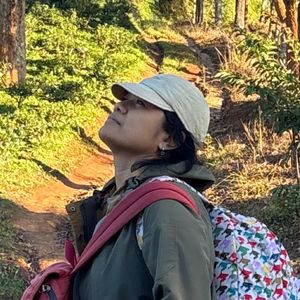
About a week ago, I received a LINE message from an older colleague. It contained a link and just two words: “In case you’re interested.”
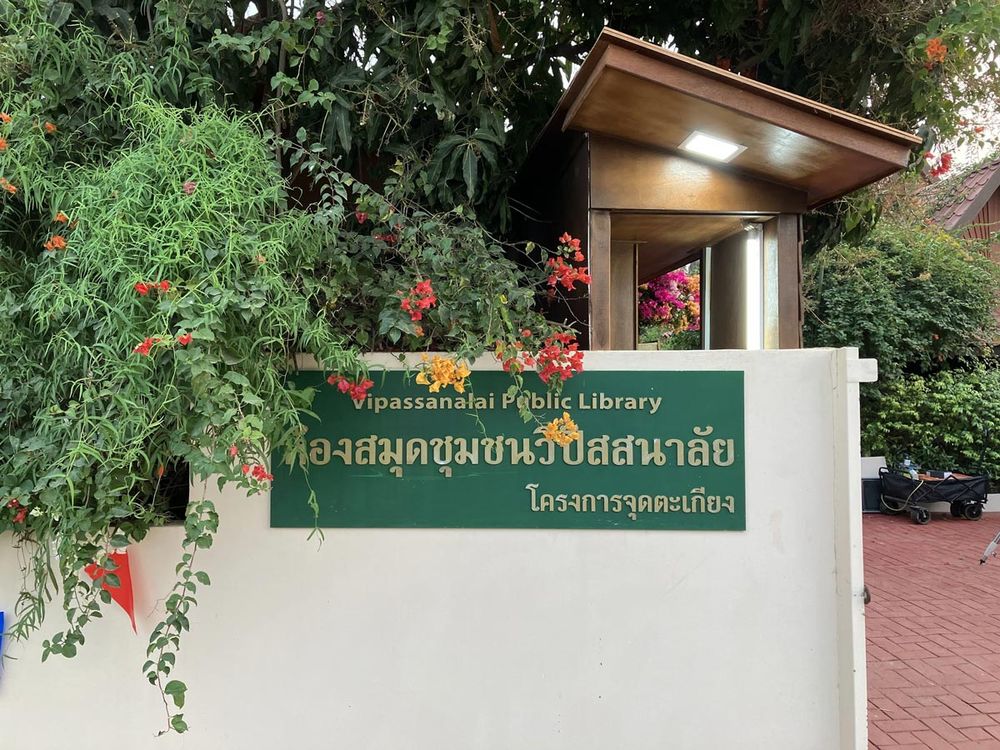
That was how I came to visit Vipassanalai Community Library in Pak Thong Chai District, Nakhon Ratchasima Province, for the first time, after hearing about the place for quite some time.
This trip felt a little special because the library was founded by Pry Pansang, a well-known writer and columnist whose work I had followed since the beginning of my career.
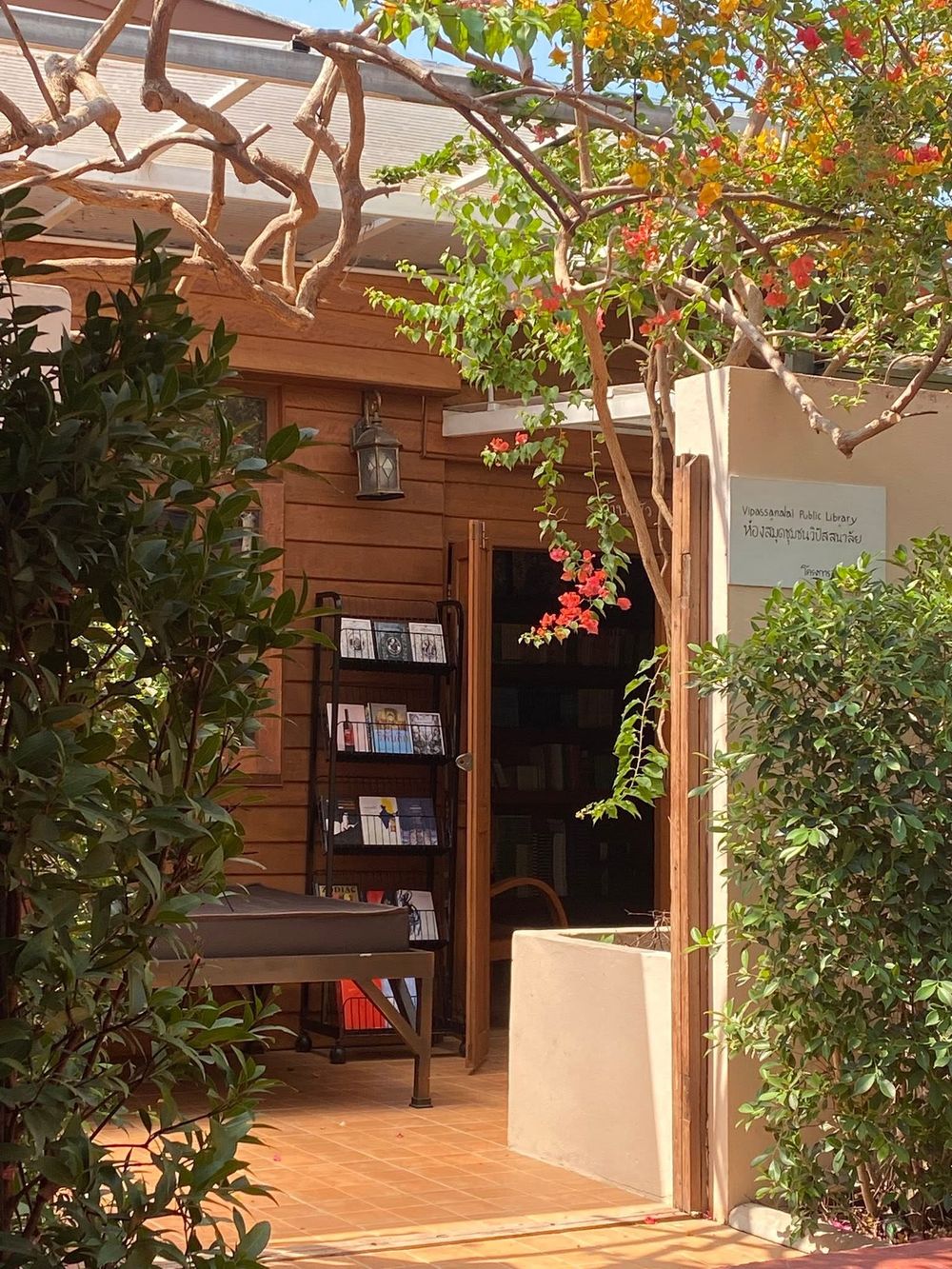
The drive from Pak Chong District did not take long. About an hour and a half later, I arrived. People standing out front pointed me toward the parking area at the adjacent Wat Phra Bueng.
Perhaps it was the library’s name that left me unsure what kind of place it actually was: a library or a meditation center. When the opportunity arose, I asked the owner directly to settle the question.
“This is a place where we pass on our valuable legacy to society. That legacy is not limited to books; it also includes knowledge and experience—what we call ‘meaningful decluttering.’ People from the community and the general public can come here to read, learn meditation, or take a healthy-cooking course,” Pry Pansang explained, succinctly yet clearly defining the library’s direction.
Pry said the library has two main goals this year. The first is to preserve Nyah Kur culture in the community before it disappears with the elders—the last generation still able to speak the Nyah Kur language. The work will involve documenting the community, interviewing elders, taking photographs, and making audio recordings, some of which has already begun.
The Nyah Kur are an Indigenous ethnic group descended from the ancient Mon people of the Dvaravati period. In their language, nyah means “people” and kur means “mountain.”
“Our other goal is to draw people away from their phone screens and invite them to create new experiences in real life, here in our library. They can then post those experiences on social media—or do whatever they wish with them. The library’s role is to create the experience.”
This perspective does not cast social media as the villain. Yet when people are swept along by its currents, their minds can become restless and confused, eventually leaving them feeling empty and depressed.
“When we come here to learn and encounter different experiences, it helps restore the proper order of priorities. Before something is posted online, it should first happen in our real lives in a valuable and meaningful way. We should experience it first, then post it—not constantly create content solely to chase engagement. Doing everything for likes and views can easily make us feel dejected or depressed, because that is a life without meaning. We try to organize activities that help people recognize the meaning of life.”
These goals gave rise to the day’s intriguing program.
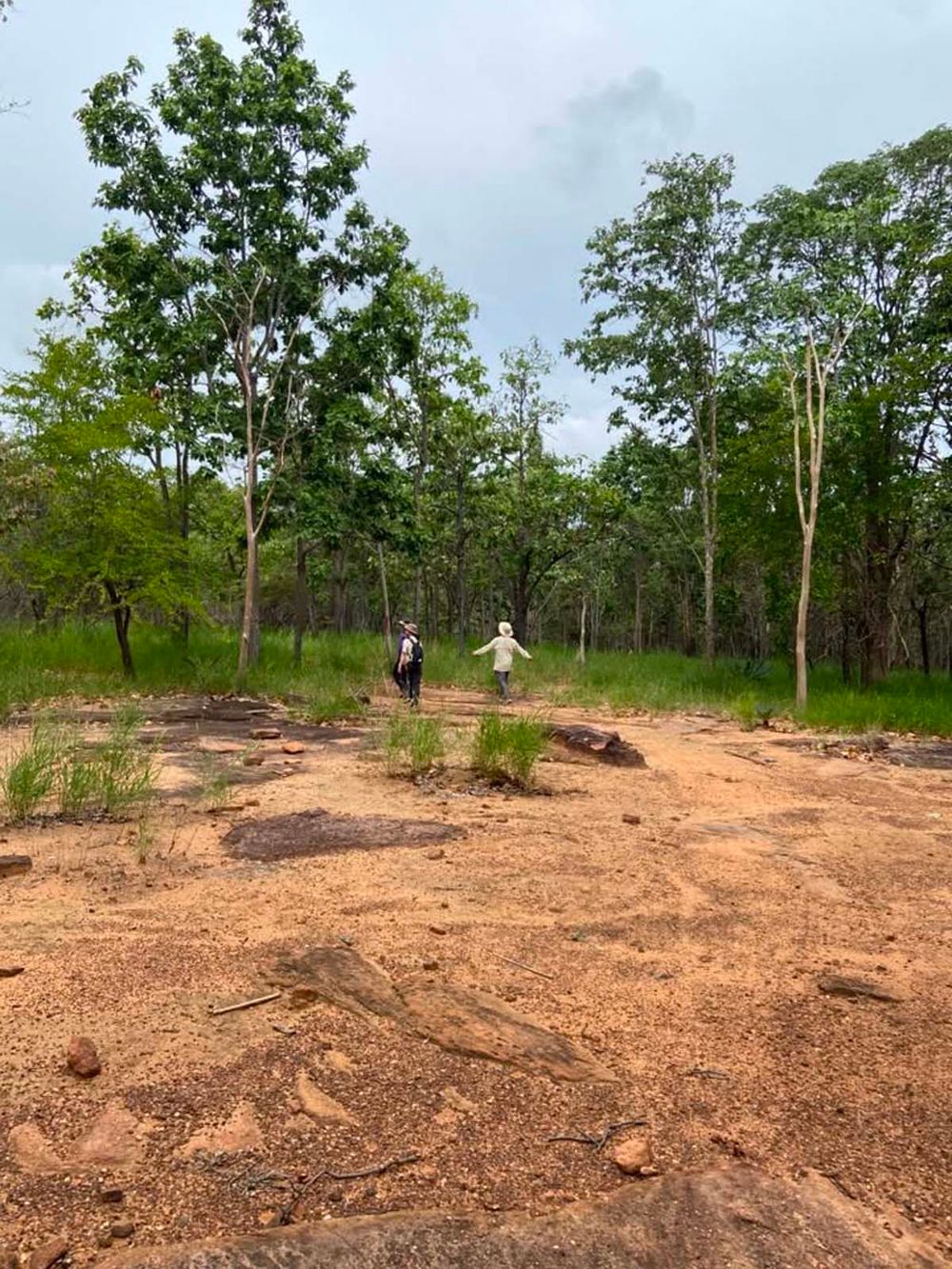
Once the registered participants had gradually arrived, we set out at 9:30 a.m. to climb the mountain behind the house. No outsider had ever set foot on this trail before; only local villagers and generations of Nyah Kur had walked it.
The mountain behind the house has a distinctive form resembling a cleaver. One side of the ridge rises steeply, while the other slopes gently into flatter ground. This type of mountain is therefore called Khao I To—“Cleaver Mountain”—or, in geological terms, a cuesta. Its geology is distinctive: sedimentary layers of sand and soil have formed clearly visible strata.
From the summit, we could see Dong Phaya Fai, or Dong Phayayen, with Khao Yai in the far distance. Looking in the other direction, we could see Wang Nam Khiao and the forests of Thap Lan.
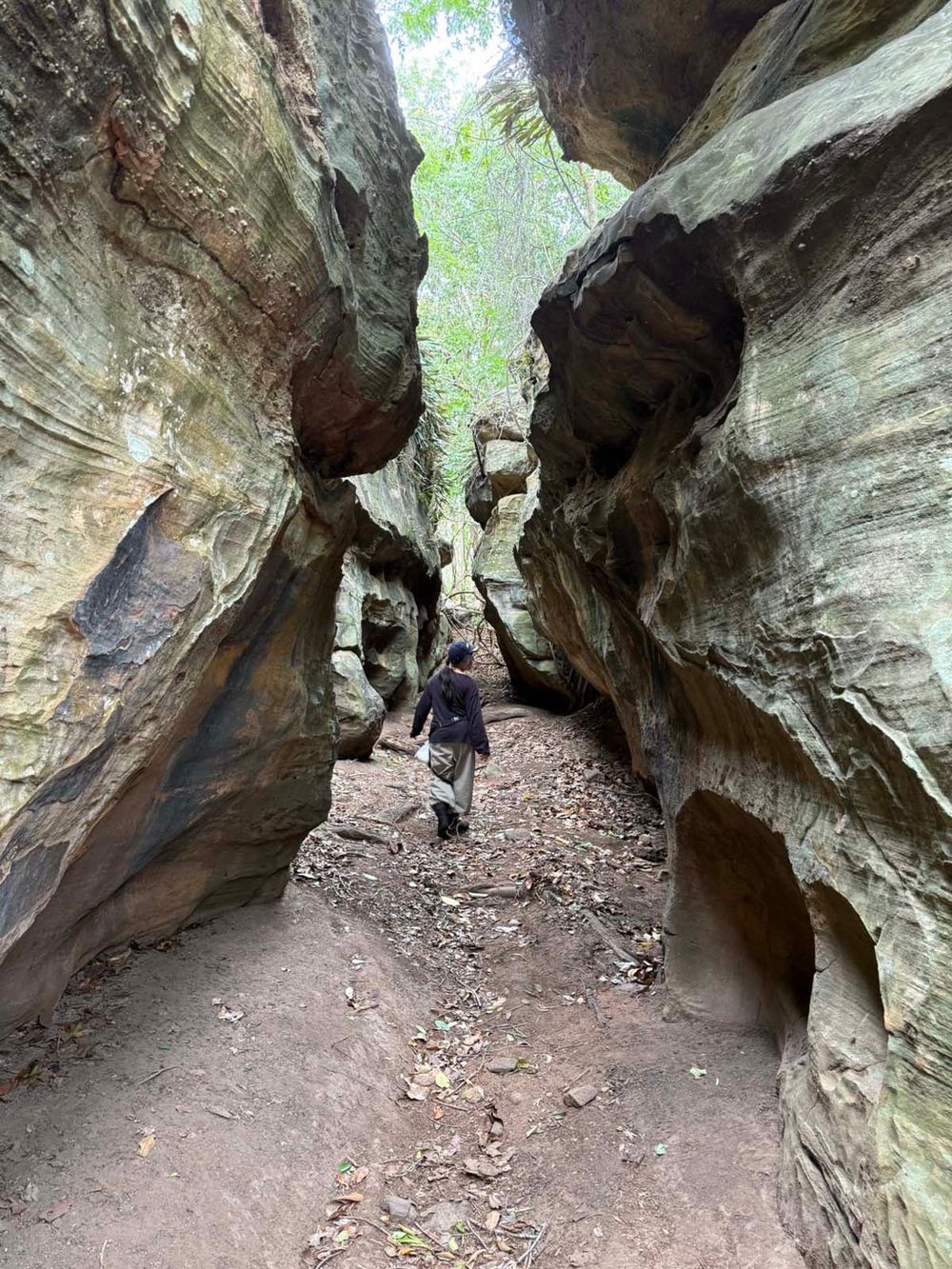
One highlight that many participants enjoyed was the rock crevice at the end of the trail, which resembles Naka Cave. A water-filled hollow there never runs dry, and remains of an ancient structure are visible above it. According to local accounts, this is an archaeological site that has never been studied.
After our walk through nature had restored the mind, it was time for lunch. We used the break to rest our bodies and prepare our minds for the afternoon’s two activities: two forms of meditation that could hardly have been more different, yet ultimately led to the same destination—a calm, concentrated mind.
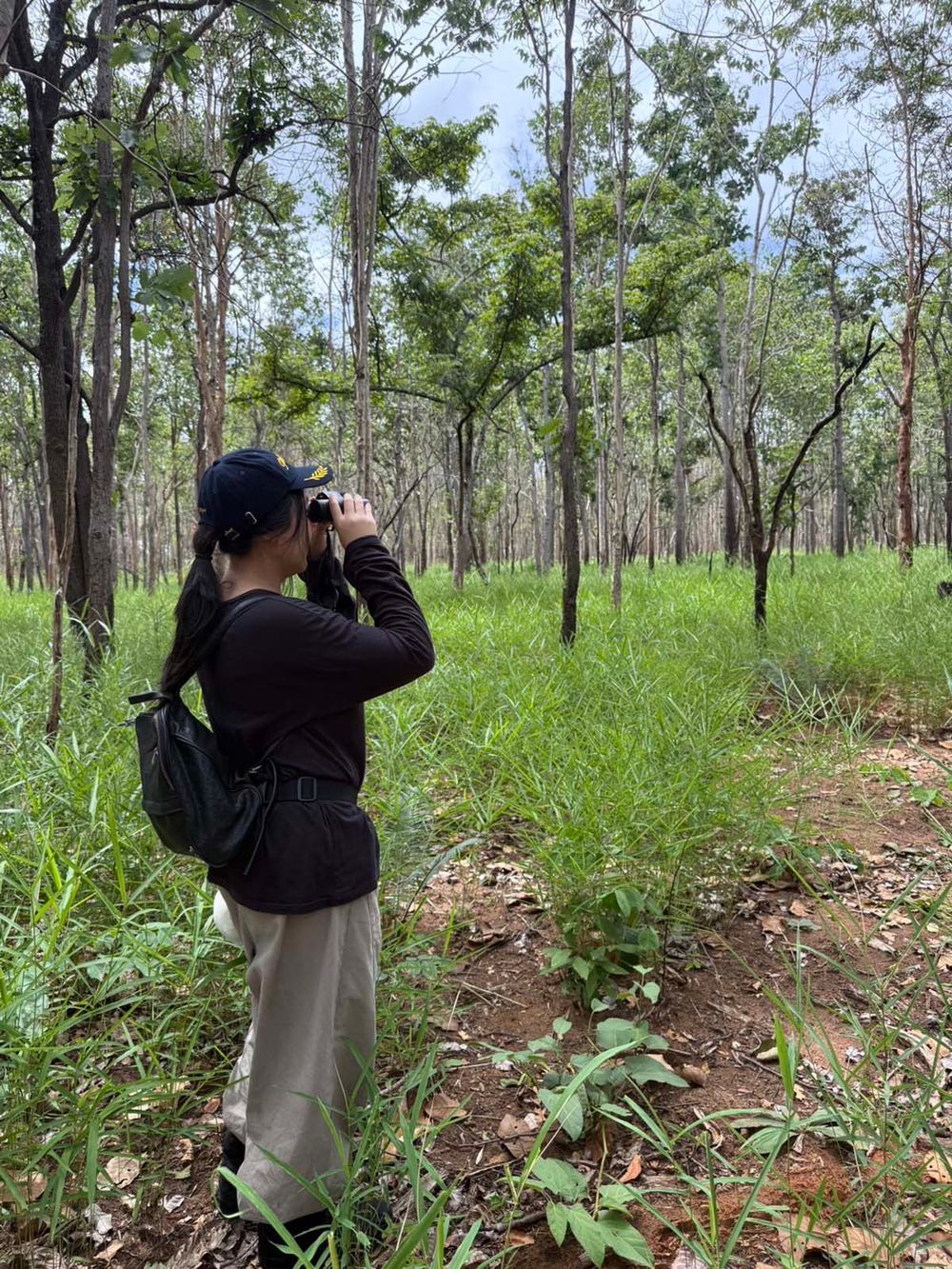
When the time came, we filed into the library to begin silent meditation based on the teachings of Luang Por Viriyang Sirintharo, led by instructor Wannapha Sakprasit. This was followed by Dynamic Meditation with Medha Devkota of Nepal, who has taken sannyas—formal initiation as a disciple—and regularly practices at Osho Tapoban. He has helped facilitate Osho therapy sessions on many occasions and is skilled in a range of Osho meditation techniques.
A brief background on Wannapha: she was formerly a mathematics teacher at Suranari Witthaya School and taught the subject throughout her career.
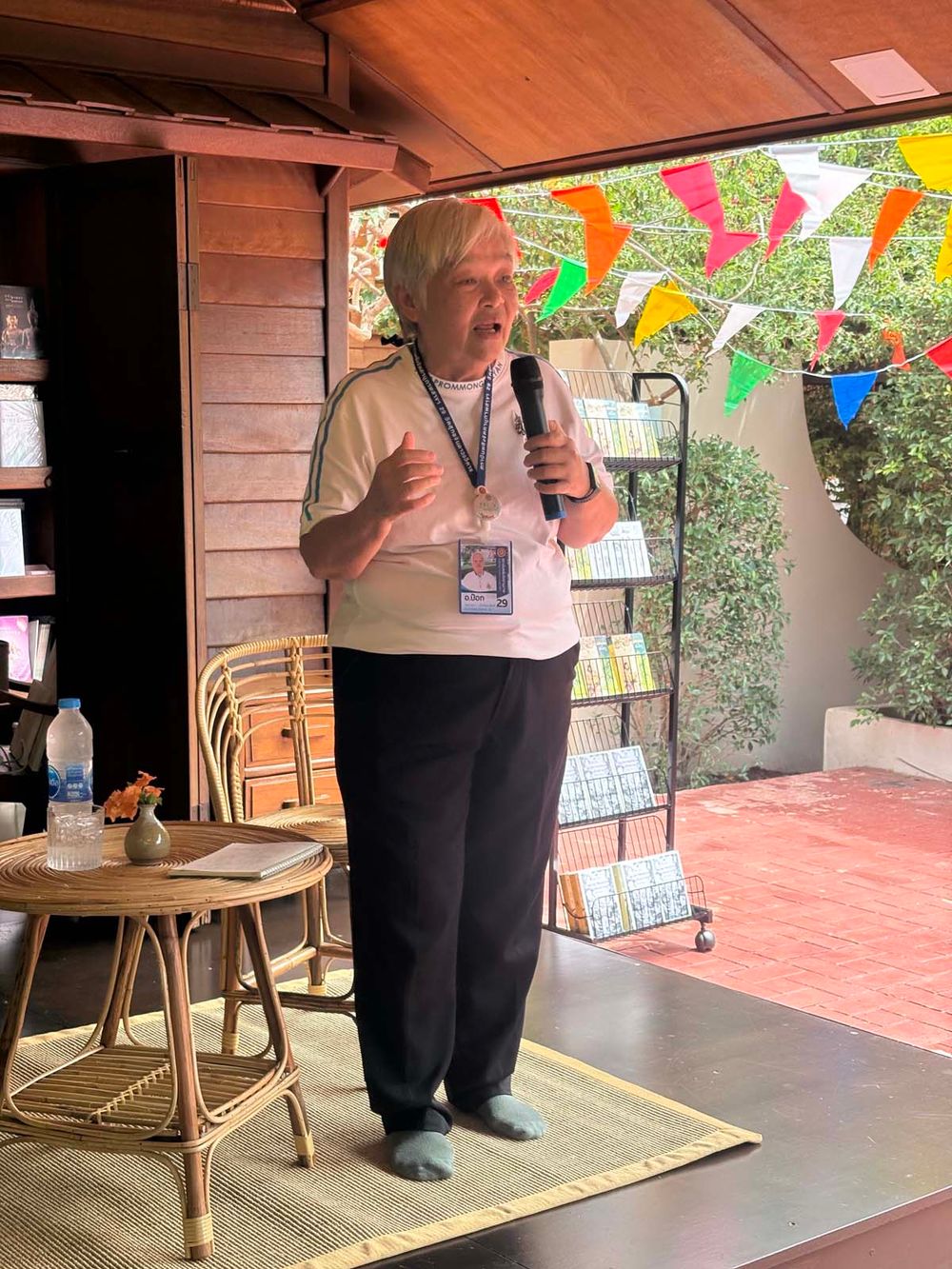
Her national ID card identified her as Buddhist, yet her everyday life remained far removed from the heart of Buddhism. Then, shortly before retirement, she encountered what she describes as the last train, with Nibbana written as its destination. She did not hesitate to jump aboard.
“Having taught mathematics all my life, whenever anyone made a claim, I took it with a grain of salt. I wondered how simply sitting and fixing the mind on ‘Buddho’ could possibly produce all those results people described. That skepticism led me to enroll in the course, and I later had the opportunity to work with Luang Por Viriyang. Ever since, my life has given me the chance to pass on his teachings and help expand his work. I am now 74 years old.”
Wannapha explained that the heart of meditation is bringing both body and mind to stillness. To reach that point, however, we must enlarge our store of mental energy until it is strong enough to exercise control. Once we can govern our own minds, we gain the mindfulness and wisdom needed to solve problems.
“When you are sitting and your mind wanders, bring it back by repeating ‘Buddho’ more rapidly. Luang Por said it is like going into battle: your thoughts are the enemy. Ordinarily, we think about all sorts of things. If we can think of Buddho alone, we become skilled at thinking of one thing. With practice, we become skilled at focusing on the word ‘Buddho’ for as long as possible. If the mind wanders, call it back. The essential thing is to calm the body and calm the mind.”
Though that afternoon’s session was brief, it was a rare stretch of truly valuable time—a jolt of awareness that a life wound so tightly it was ready to burst needed to ease its grip and recognize its true purpose.
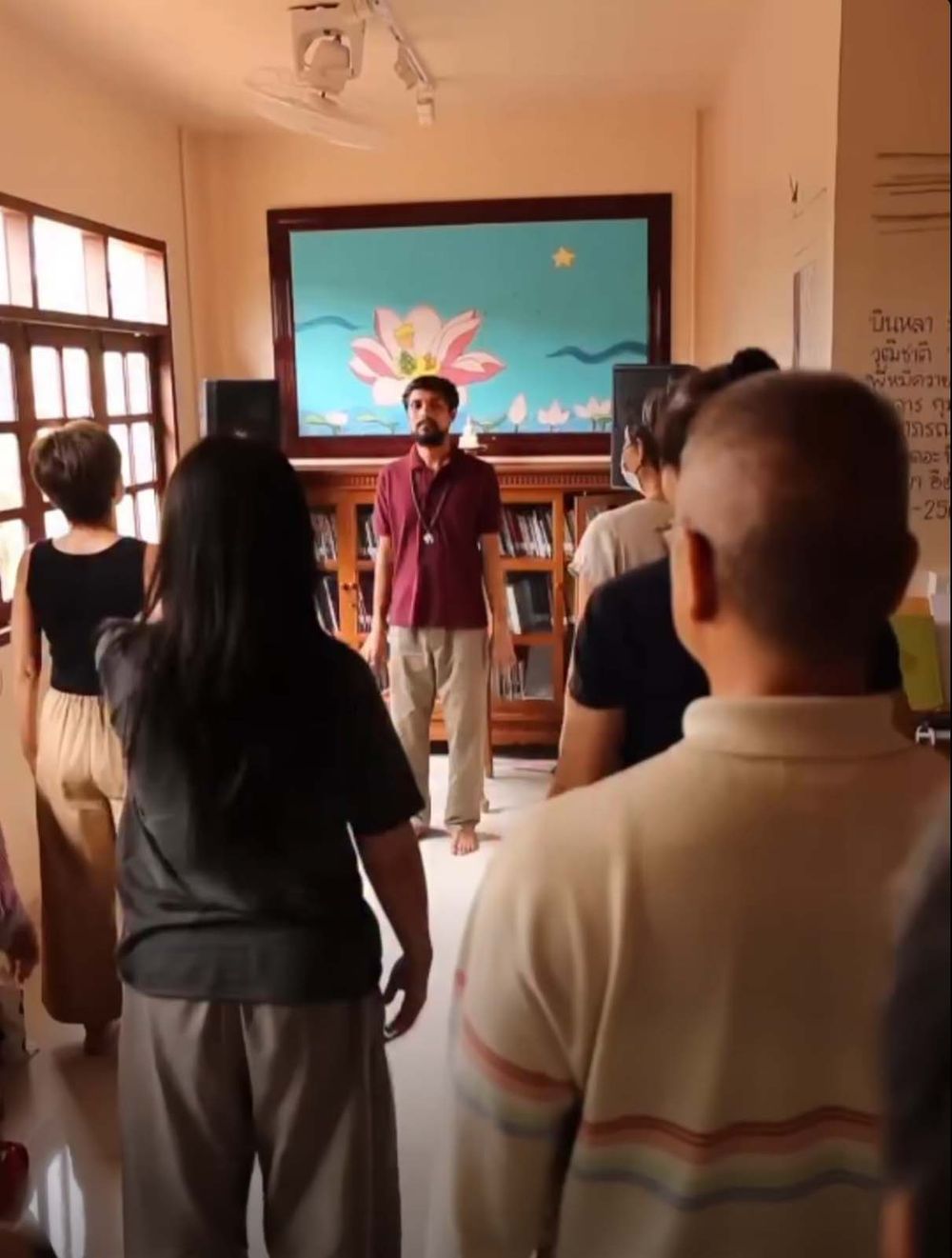
After taking a short break from silent meditation, it was time for Dynamic Meditation with Medha, who had studied a range of meditative practices using Osho’s techniques.
Everyone seemed excited by the activity because it was so different from the familiar practices of Thai Buddhism. The session lasted one hour and was divided into four 15-minute stages, each accompanied by music matched to its rhythm.
The first stage involved shaking the entire body while remaining aware of the feet touching the floor.
Next came dancing, allowing the body to move freely with the rhythm of the music.
We then sat upright, either leaning against a wall or sitting unsupported. In this stage, attention returned to the mind, with the music guiding us into meditation.
Finally, we lay flat on the floor, allowing body and mind to relax completely.
Surprisingly, this unfamiliar form of active meditation drew us into a meditative state with astonishing speed.
That helps explain why this form of meditation is becoming increasingly well received, especially among people caught in the confusion and commotion of urban life. The moment we release our energy through shaking and dancing, it feels like a discharge. Once that tension has been released, the mind can return to stillness.
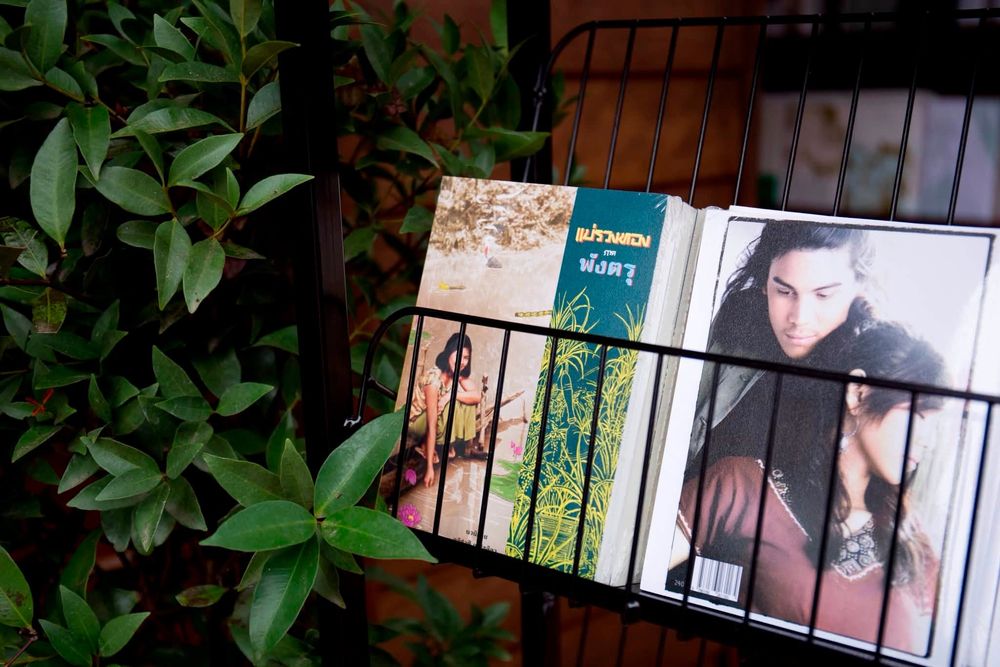
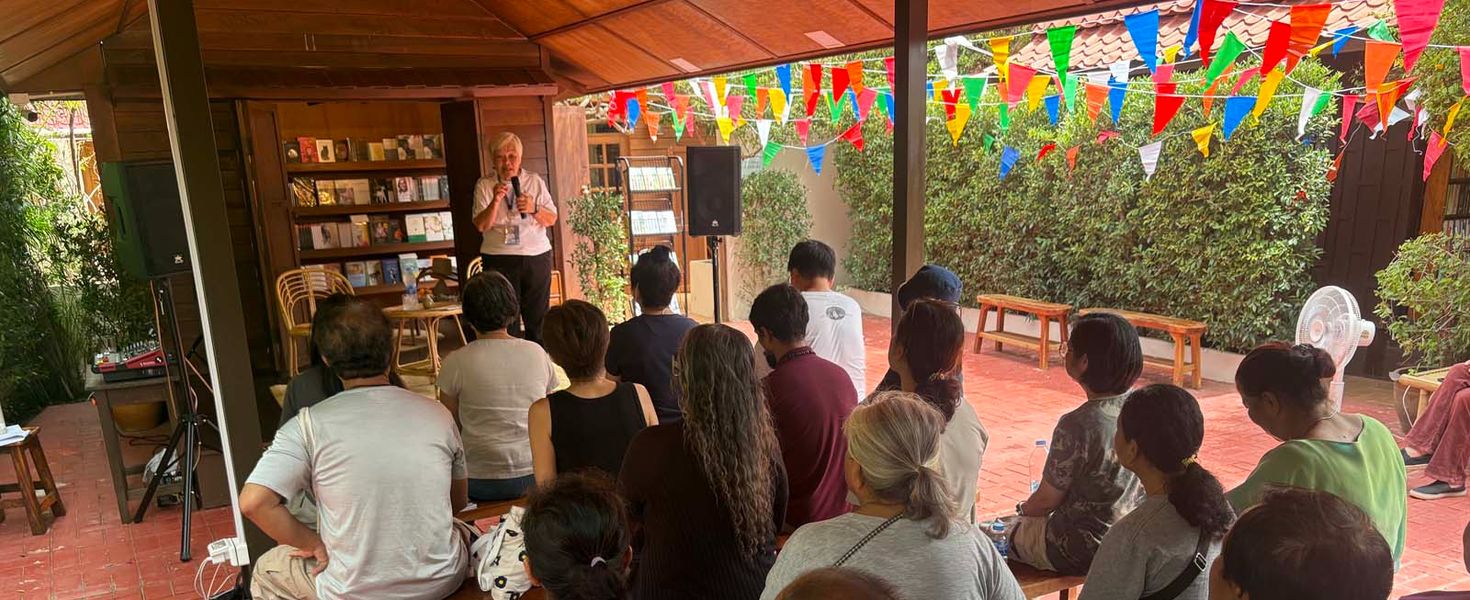
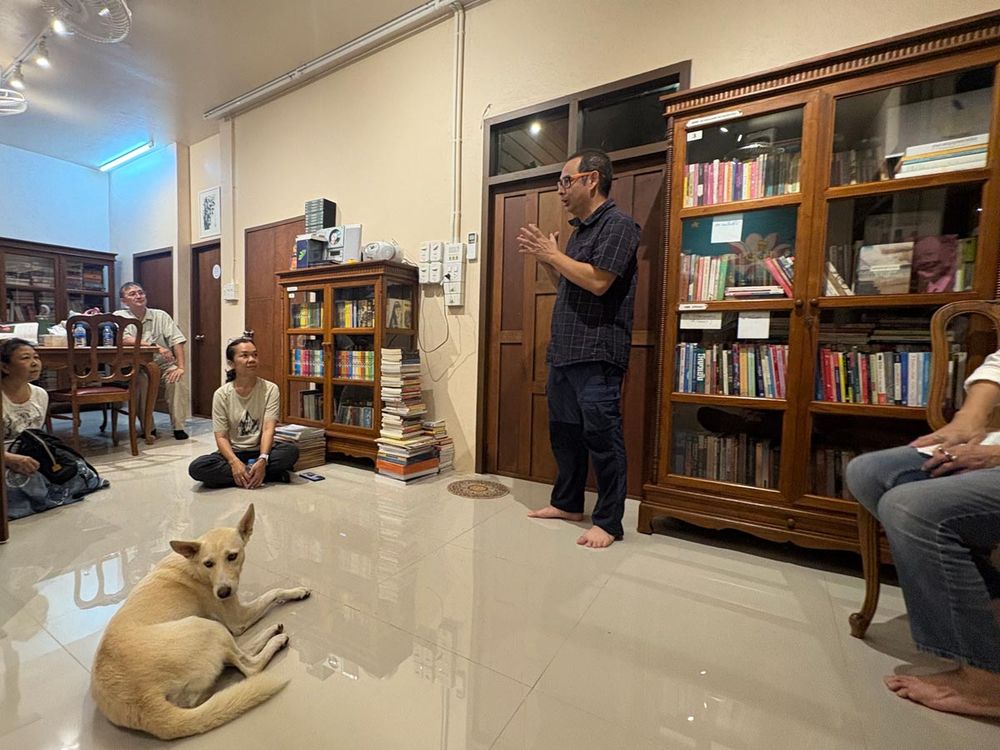
After the two meditation sessions, the evening brought a literary talk on Mae Ruang Thong: Phang Tru, the eighth and latest work by Aphichat Phetlila, creator of the iconic Khai Yoi and Dakanda from Dear Dakanda. The conversation was moderated by Wirawat Somnuek.
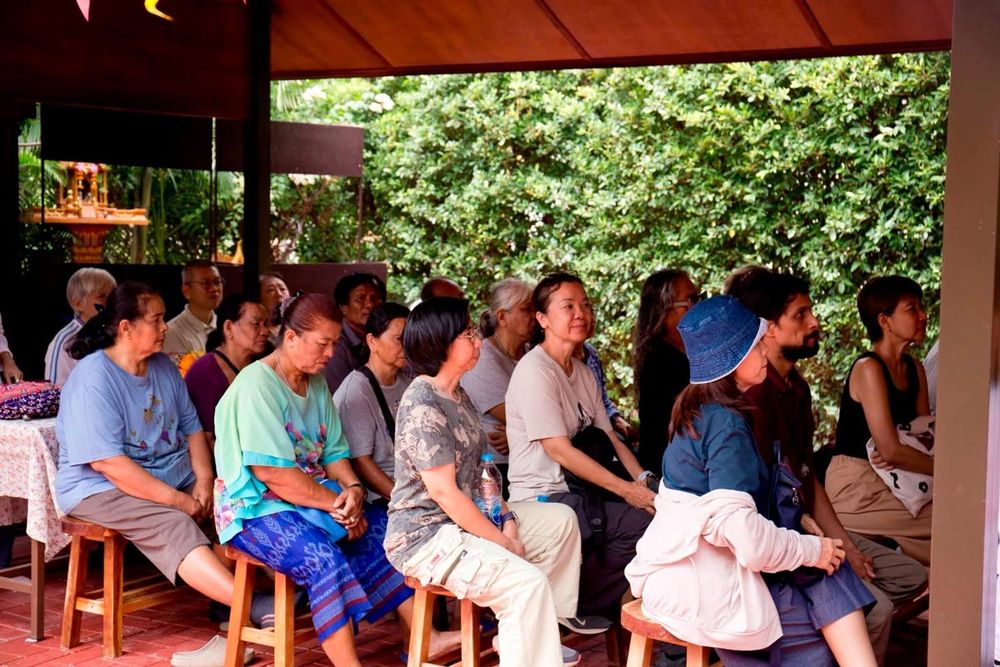
Everyone listened attentively. The author spoke about his fiction-writing process, explaining that his stories must emerge from fragments of lived experience. He cannot write purely from imagination; even if he can produce the words, he takes no pleasure in the work.
For that reason, Aphichat Phetlila’s works—from the celebrated Klong Praisani Si Daeng (The Red Mailbox) and Yak Hai Lom Nao Huan Ma Ik Khrang (I Wish the Winter Wind Would Return Once More) to a weightier work such as Mae (Mother)—all arise from fragments of life.
Mae Ruang Thong: Phang Tru is no exception.
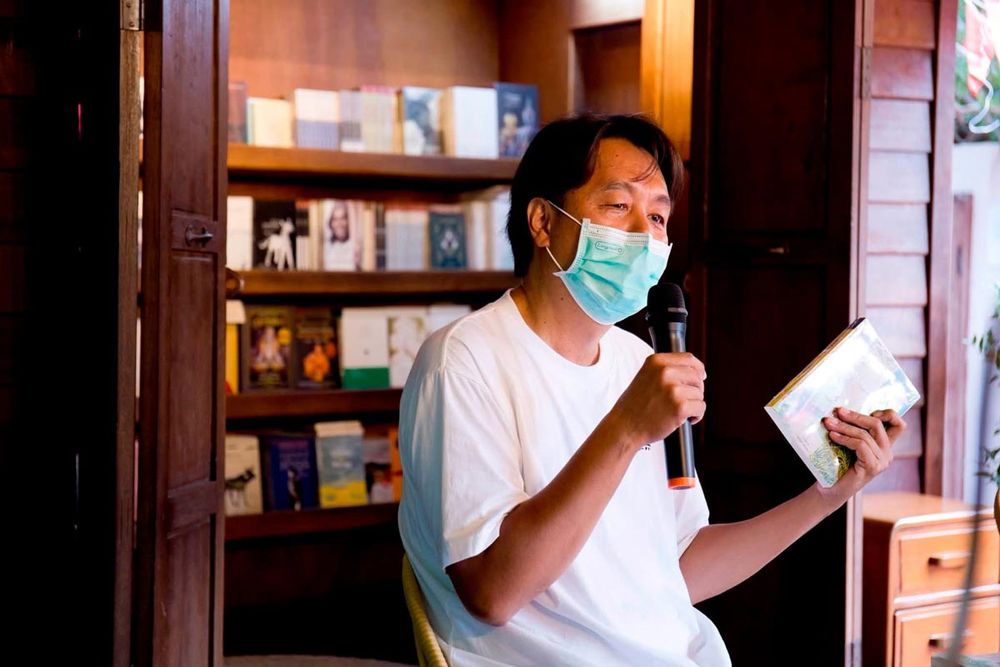
“When I wrote Mae, it reflected the economy around 1997, when the Tom Yum Kung financial crisis affected people across Thailand. It reflected society in that way. I wanted to write something that would make people recognize that this was not adolescent fiction. Once I finished it, I never read it again. Then one night, I thought I should return to Mae and make the story complete, because I had written it as a young man and had not told my mother’s story in full.”
Aphichat explained that the earlier story covered his mother’s life as a young woman from the countryside who moved to Bangkok for work, met his father, and, through circumstance, came to live in a slum. What it lacked were scenes rooted in Phang Tru Subdistrict, Phanom Thuan District—her birthplace. After he built a house in Phang Tru and his mother, now 79, moved in with him, they had more time to talk. Living amid the setting of his ancestors convinced him that he should complete her story.
“I write what I want to write. I want to preserve fragments of my own life. Although this is the story of a single family, it is also a reflection of the country and of other families. It is a complete work of literature, with politics and revolution, because it follows my mother from her youth in 1957 through the 2006 coup against Thaksin. And the story is genuinely held together by our roots: growing sugarcane and rice, the golden age of Thai cinema, Mitr Chaibancha, and Suraphol Sombatcharoen. All of these become representatives—a vivid portrait of our country.
This book is a love letter to the past. It is the most complete work I have written. I hope the story and its value will be strong enough for readers to recommend it by word of mouth. I spent two years writing it, and I am satisfied with the result. In the future, I would like to write another volume. If Mae Ruang Thong is complete in two volumes, I could die without regret. Whether or not I write anything afterward, I will have fulfilled my intention to preserve our story in literature.”
After the literary talk, the original plan was to observe the night sky with Chon Wichaidit, author of Teh Fa Atsachan (Amazing Celestial Objects), one of Thailand’s most comprehensive books on celestial objects. Unfortunately, rain clouds refused to cooperate, leaving us able only to talk together inside the library.
But that is precisely the point. As Chon once said, nature is simply nature. On a day we have eagerly awaited, factors beyond our control may still leave us disappointed.
Living close to nature therefore does more than heal the heart; it also reveals life’s truths and deepens our understanding of what life means.
Even after the activities had ended, I found myself grateful to the colleague who had sent me such welcome news.
For those interested in future events, Pry said the library will initially organize one or two activities a month. Once everything is running smoothly, they may be held every week.
Anyone who missed this session need not be disappointed. More worthwhile activities like it will certainly follow. Those interested can keep up with them on the “Pry Pansang” page.
© 2025 Khaoyai Connect. All rights reserved.
No part of this content may be copied, modified, or distributed in any form without prior written permission.
