


Phimai:
The Birthplace of Civilization and the Architectural Prototype for the Grandeur of Angkor Wat
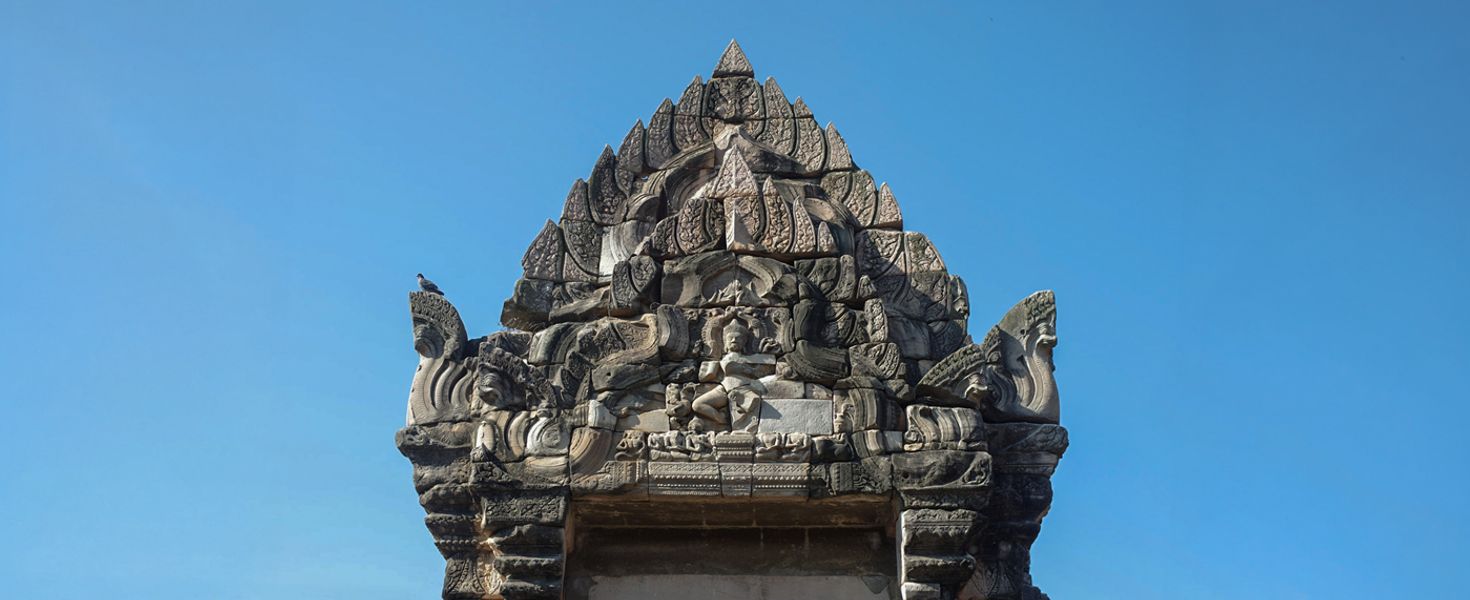
If asked which cities in Nakhon Ratchasima (Korat) are worth a visit, one could immediately answer: “Phimai.” It is a destination every Thai person should visit at least once, as Phimai is an ancient city steeped in a long history. Most importantly, it serves as the source of the Angkor Wat art style—one of the world's most magnificent temple complexes.
The development of Phimai as a settlement is fascinating across different eras. It began as a Metal Age community during the late prehistoric period, roughly 1,500–3,000 years before the Buddhist Era. During this time, humans transitioned from using stone to metal. Excavations have uncovered tools primarily made of iron, bronze ornaments, and “Phimai Dam” (burnished black earthenware).
As time turned toward the historical era, around 1101–1200 B.E., Phimai served as a border town where Khmer cultural influences were exchanged back and forth with Cambodia. It flourished significantly under the influence of Dvaravati culture. Over 700 years later, Phimai pledged its allegiance to Ayutthaya, becoming a major town under Nakhon Ratchasima during the reign of King Narai the Great.
Just over 100 years ago, during the reign of King Rama V, Phimai became part of the Monthon Thesaphiban Nakhon Ratchasima under the Ministry of Interior, eventually gaining its current status as a district within Nakhon Ratchasima Province.
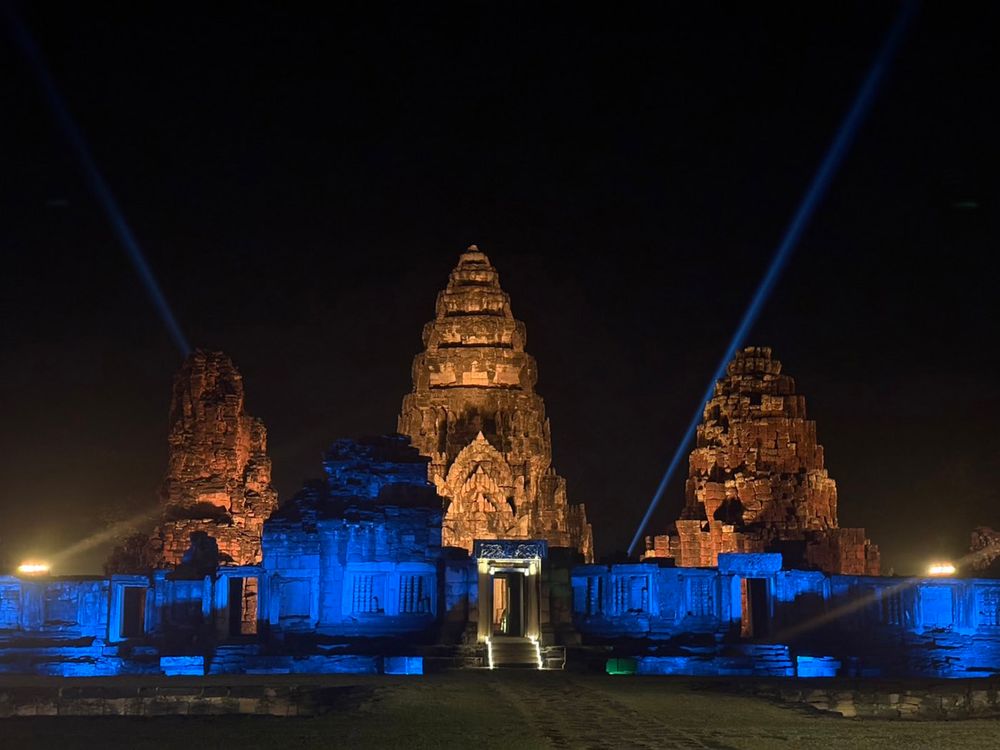
Today, Phimai is a major national tourism destination.
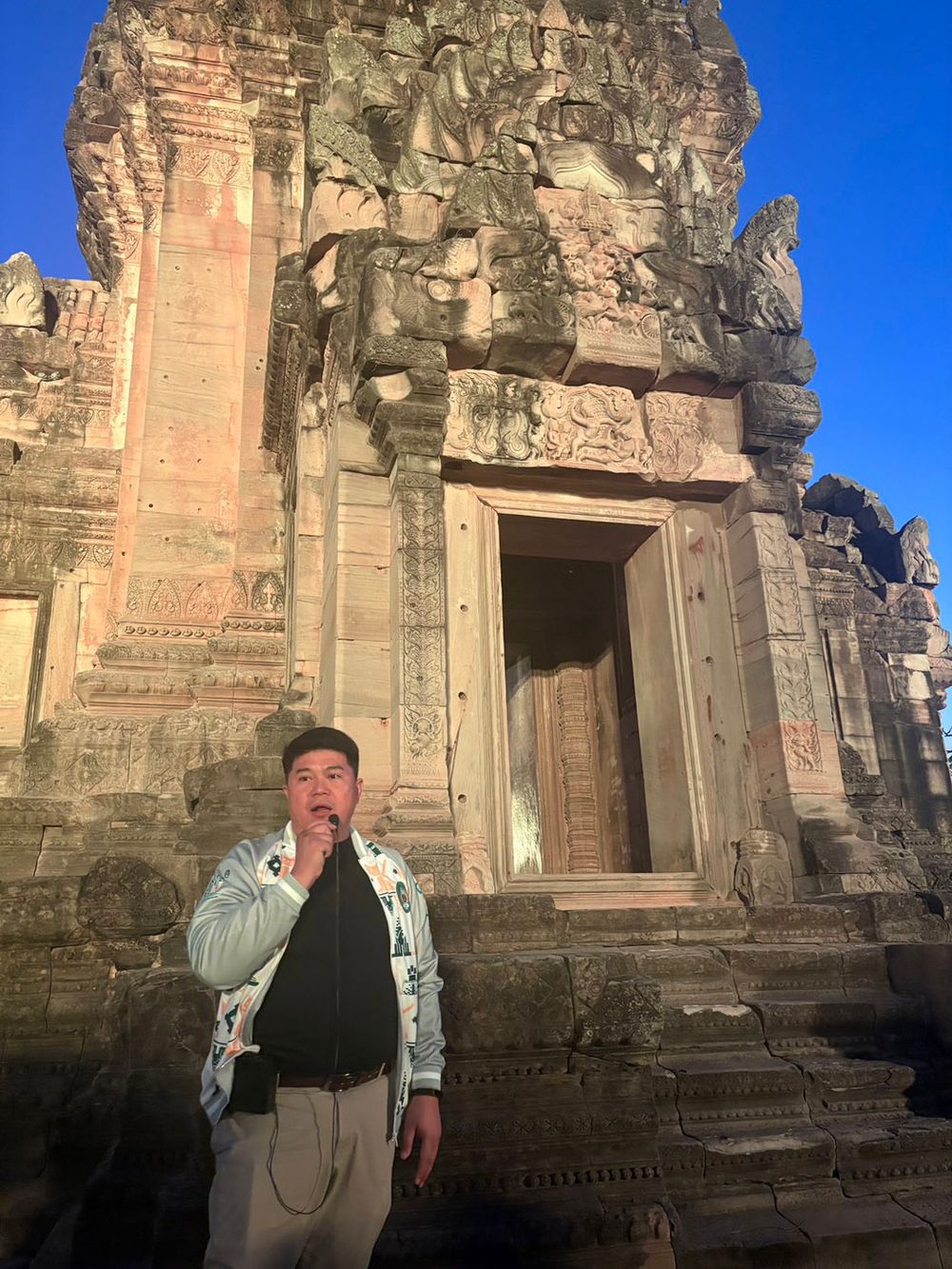
The joy of visiting Phimai lies in discovering the diverse stories of each era. This experience becomes even more vibrant when Khaoyai Connect had the opportunity to explore the city with Asst. Prof. Phitakchai Jattuchai, also known as “Ajarn Tutta,” the Director of the Art and Culture Office at Nakhon Ratchasima Rajabhat University. He is a scholar renowned for narrating history with a rare, captivating flair.
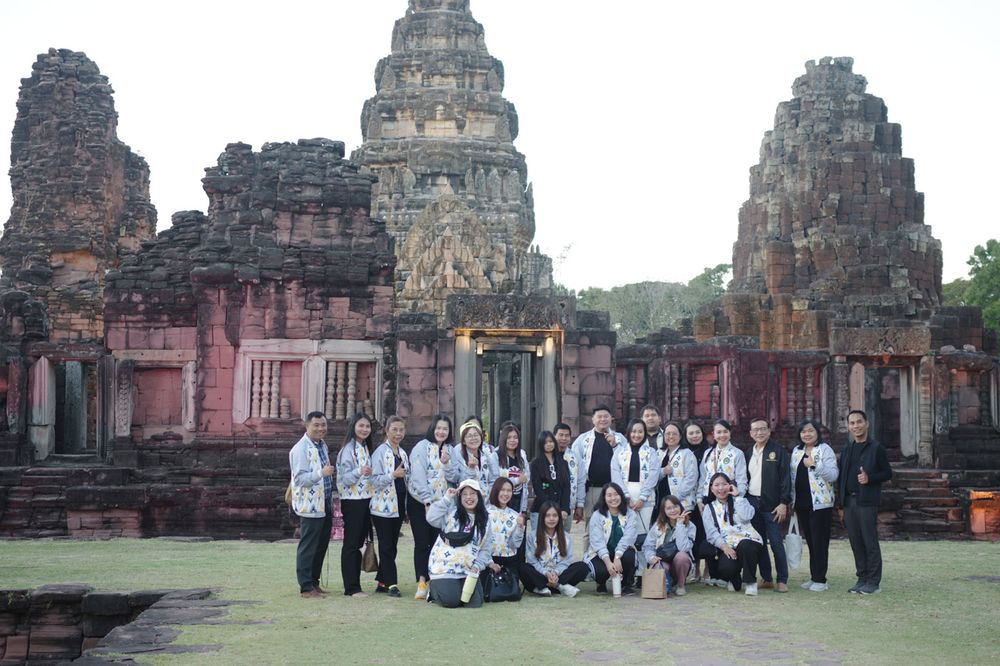
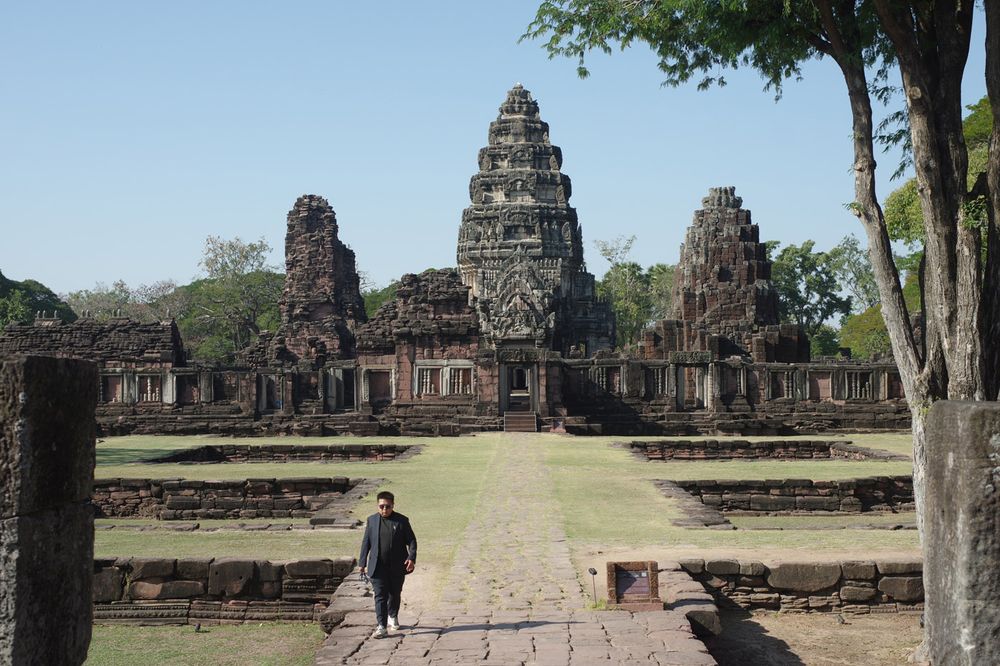
As usual, we met in the evening. Our walk began at the Victory Gate (Pratu Chai), heading toward the Phimai Sanctuary located in the Phimai Historical Park, which could be seen in the distance.
Cart Ruts to the Salt Trade: The “White Gold” of the Mun River, Phimai's Most Valuable Resource
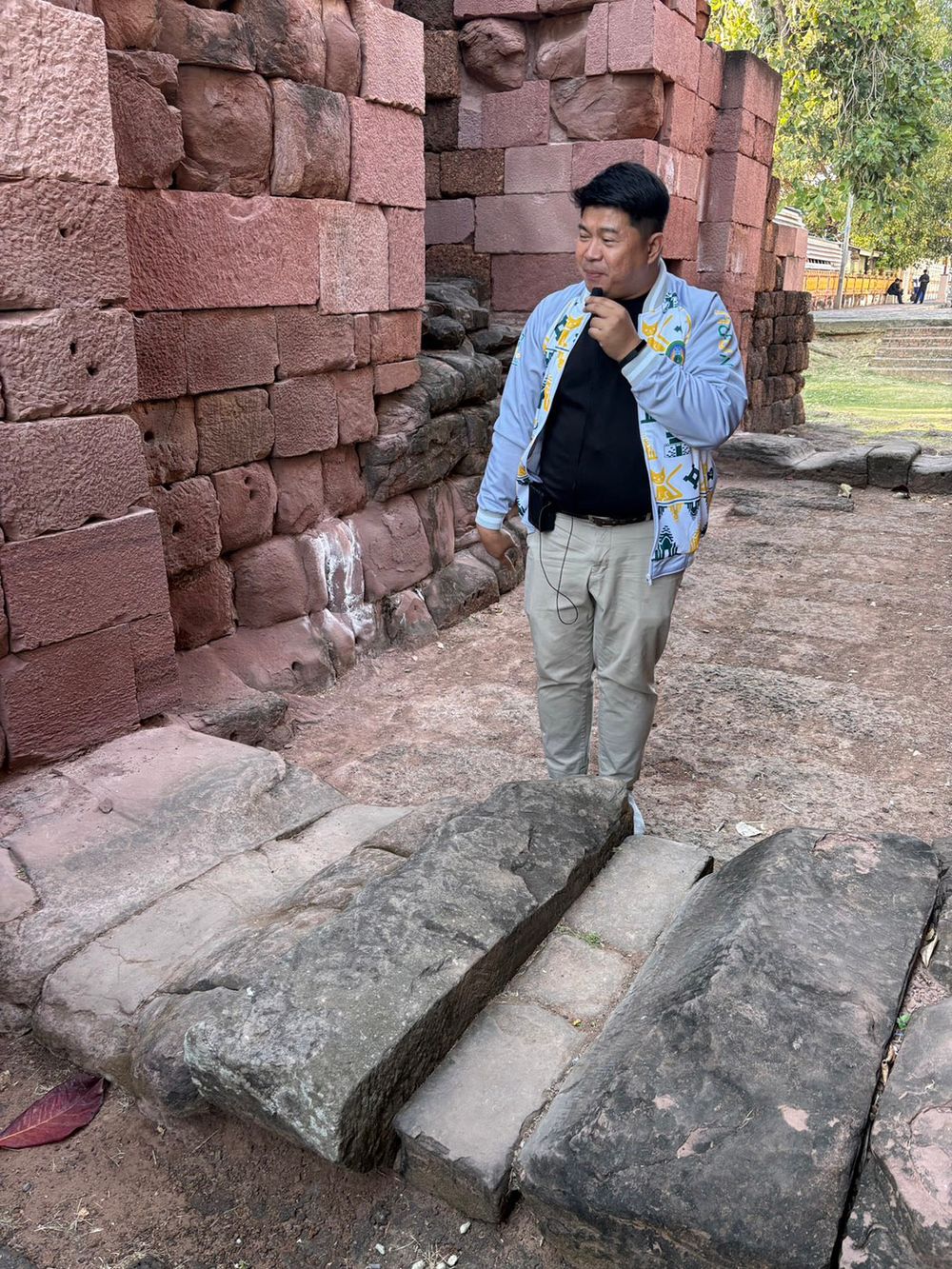
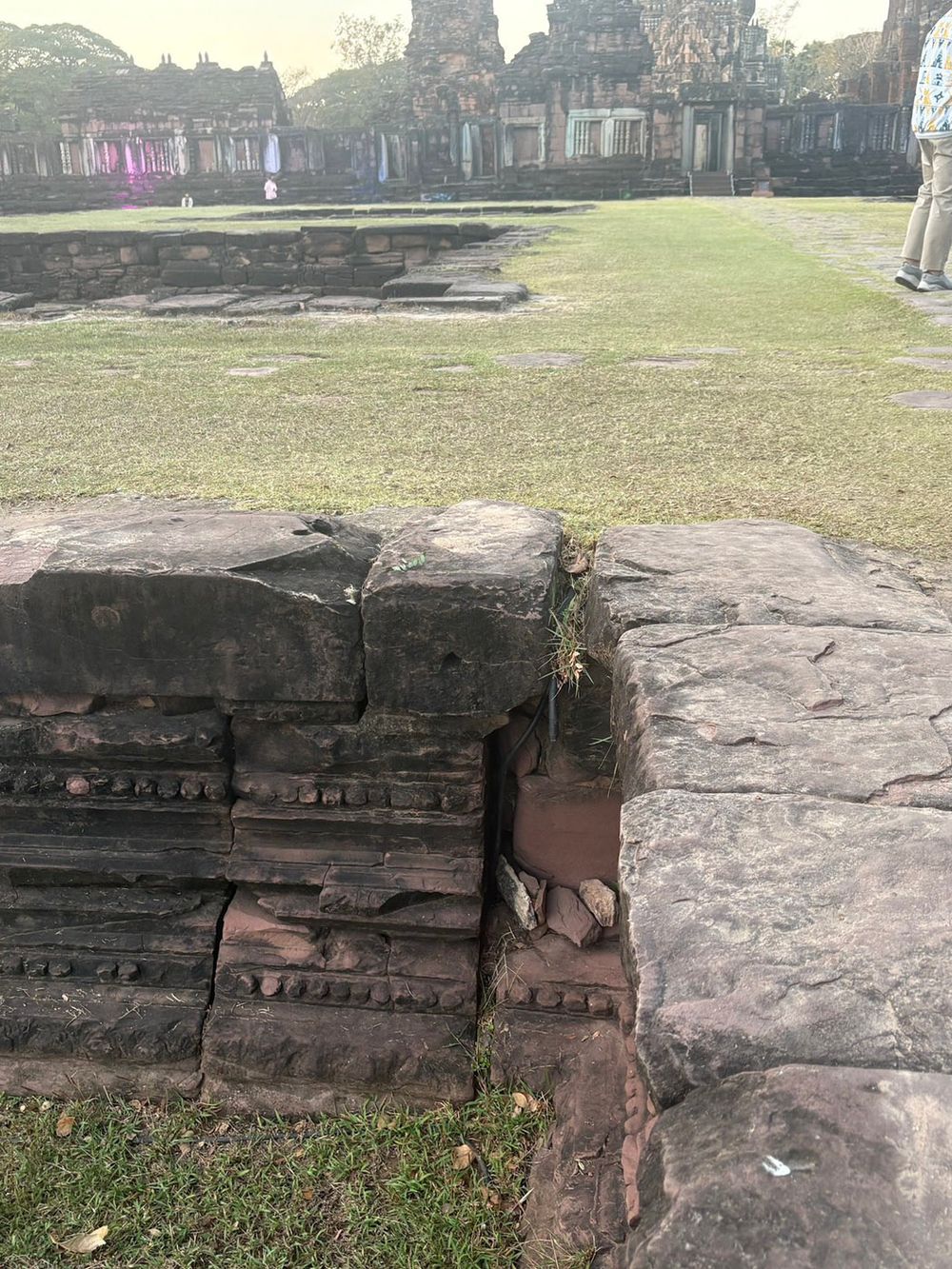
At the Victory Gate, if you observe closely, you will see two shallow ruts stretching for a short distance. Our lead historian revealed that these are ruts formed by the passage of carts. Over time, the ground wore down into grooves following the rotation of wheels that bore the weight of people and goods.
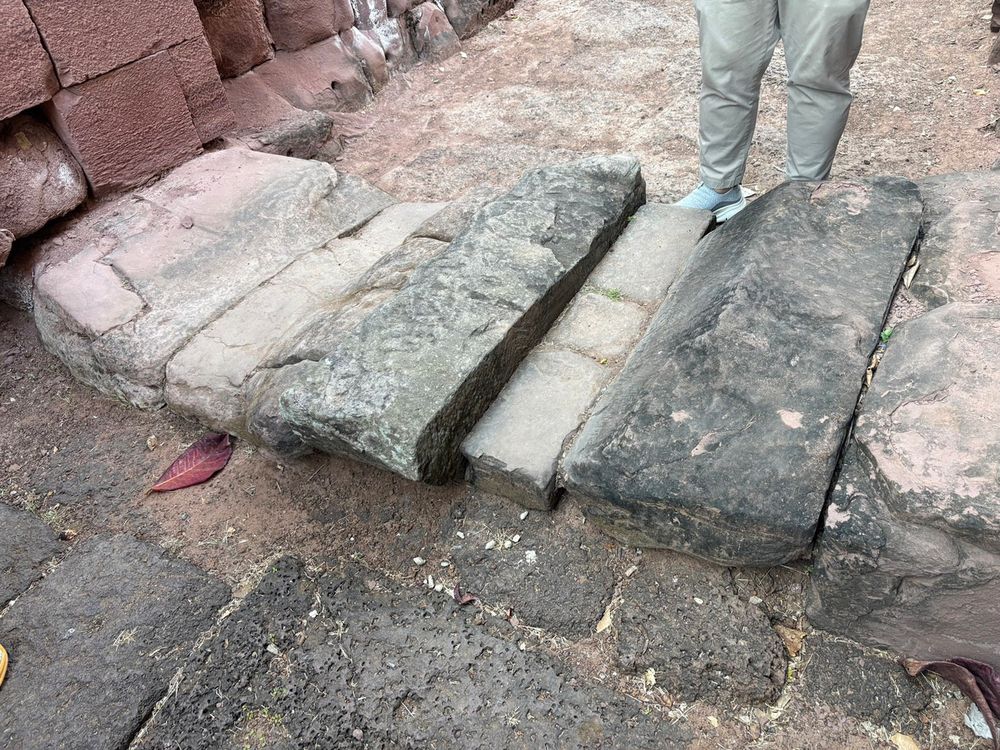
In a past era, carts were essential vehicles for transporting goods to be sold or exchanged with other cities. This was particularly true for “salt,” considered a precious resource—the “white gold” of the Mun River—which was sold to Cambodia. On the return trip, these carts would transport dried fish from Battambang to sustain the people of Phimai.
Ajarn Phitakchai further explained that although Phimai has three main rivers—the Khem, Chakkarat, and Mun Rivers—they still needed to purchase additional fish from Battambang. The local supply was insufficient to feed the population because Phimai had been a “hub” or a commercial center for the surrounding region since ancient times.
“Salt was a very precious resource for Phimai. The city grew and became powerful through salt production, as there is a salt layer nearly 200 meters thick here. However, it wasn't industrial salt; it was produced from ‘Khee-ka-tha’ (salt efflorescence from the soil surface). It was very high-quality salt. Battambang, which borders the Tonlé Sap, was famous for being a massive fish source and had a fermented fish (Pla-ra) industry. They would use Phimai salt for the process because of its quality. In later years, the traditional ‘Khee-ka-tha’ salt-making process began to disappear from Phimai.”
Thus, Phimai has always been a trade center, even as recently as 30–40 years ago.
“For anyone aged 50–60, if you wanted to buy anything, you had to come here. Whether it was Spring Song powder or fishing nets and traps, you had to buy them in Phimai because it was the hub. Consequently, the bus station in Phimai was extremely bustling back then.”
An Ancient Path to Chom Suda Sadet Road: Phimai's Commercial District
Passing through the Victory Gate, we see parts of a road paved with laterite. Archaeological excavations found that laterite paving once extended from the Victory Gate all the way to the Phimai Sanctuary. However, due to modern road construction and filling, it is no longer entirely visible.
While walking along the path, one of the tour members asked the leader about the name “Chom Suda Sadet Road.”
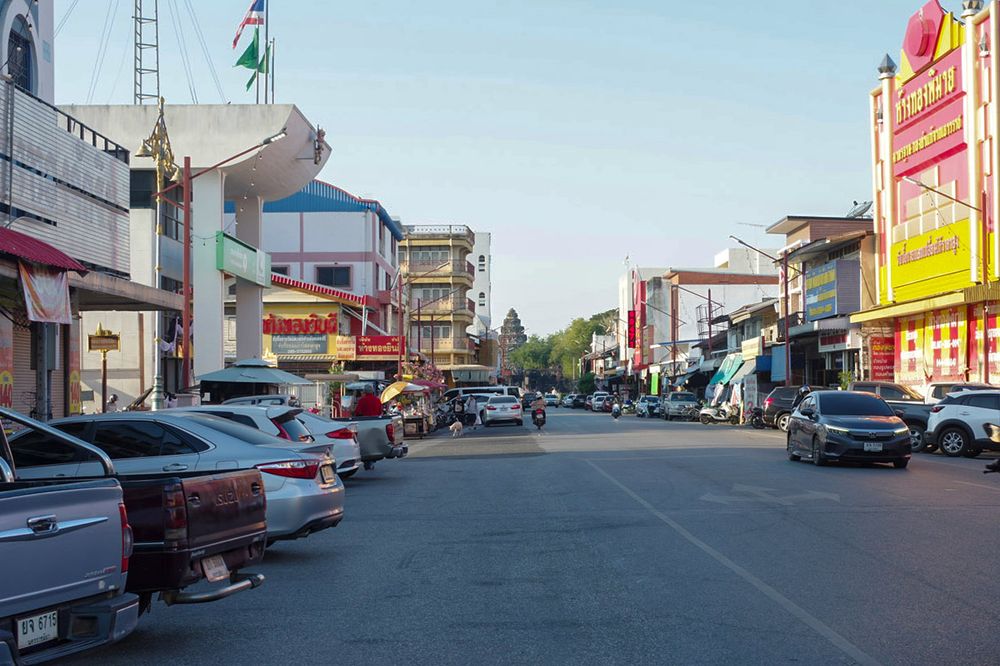
The answer was that the name was chosen by the people of Phimai to commemorate the visit of Her Majesty Queen Saovabha Phongsri, the Queen Mother.
Ajarn Phitakchai shared that King Rama V very much desired to visit Nakhon Ratchasima. He once remarked that if illness would permit him, he would visit Nakhon Ratchasima before any European country. Ultimately, King Rama V visited Europe before he could make it to Nakhon Ratchasima. A year after his passing, Her Majesty Queen Saovabha Phongsri, the Queen Mother, visited Nakhon Ratchasima and Phimai.
“In Phimai, Her Majesty wished to see two things: first, the Banyan tree rumored to be exceptionally beautiful, which is the origin of the name ‘Sai Ngam’; and second, the Phimai Sanctuary, said to be stunning and grand. She stayed at a pavilion in front of the sanctuary and visited it. During her stay, she traveled back and forth along this very road. The people of Phimai wanted to honor her, so they named it ‘Chom Suda Sadet Road.’ ‘Chom Suda’ translates to ‘The Great Queen.’ Since then, the road has been known by this name.”
During that era, Phimai’s economy remained very vibrant. With the railway reaching Korat, more Teochew and Hakka Chinese immigrants were attracted to start businesses. Once established in the city, these families would send their children to other towns—a system of family trade. Naturally, Phimai was on the list of places where Chinese families sent their descendants to expand their business ventures.
“In the past, Phimai was filled with foreign tourists. Many guesthouses lined the alleys. Japanese visitors enjoyed cycling around the city, followed by the French and Germans. They loved the old town, the sanctuary, and staying in guesthouses. Places like Boonsiri Guesthouse still host foreigners today, though things have become quieter and more stagnant lately. Many shops have changed their form significantly.”
Chokvakul (Pikul Grove): The Original Name of Phimai
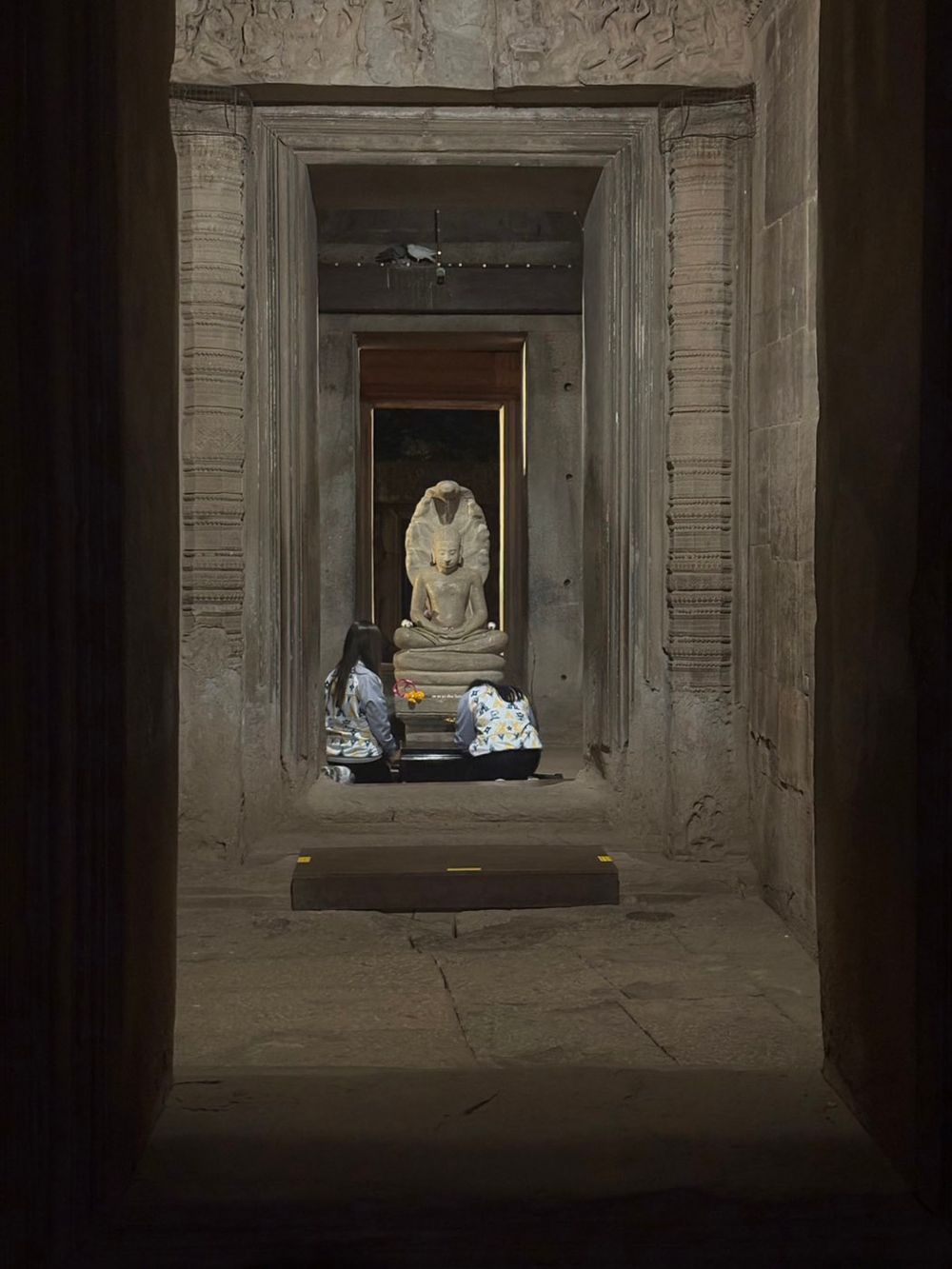
Originally, the word “Phimai” was not the name of the city but came from the name of a sacred Buddha image in the Naga-protected pose (Pang Nak Prok) named Kamrateng Jagat Vimaya. King Jayaviravarman dedicated this image along with land in 1551 B.E., marking the first appearance of the word “Vimaya.” This indicates that “Vimaya”—which later became Phimai—was not initially a city name but the name of the venerated Naga-protected image.
Meanwhile, the original city name found in inscriptions was “Chokvakul,” which means “Grove of Pikul (Mimusops elengi) Trees.” The name changed several times over the years, with the final name being Vimayapura, appearing in the inscriptions of King Jayavarman VII.
“Later on, we began calling it the city of Vimaya, which eventually became Phimai. But in reality, Vimaya or Phimai was not the city's name from the start; it was the name of the idol or Buddha image,” Ajarn Phitakchai emphasized.
Hypothesis on the Builder of Phimai Sanctuary: King Jayavarman VI
Although no inscription explicitly names the builder of Phimai Sanctuary, the “Phimai 3” inscription suggests it was likely built during the reign of King Jayavarman VI, approximately 1623–1650 B.E. The content of the Phimai 3 inscription mentions his younger brother, King Dharanindravarman I, who succeeded him, stating that he ordered the installation of an idol named Kamrateng Jagat Senapati Trailokyavijaya as an attendant to Kamrateng Jagat Vimaya within the Phimai Sanctuary.
This indicates that the inscription must have been created when the sanctuary already existed. Naturally, the sanctuary must have been built during the preceding reign, which was that of King Jayavarman VI. The Phimai Sanctuary was constructed as a Buddhist site following the Mahayana-Vajrayana tradition.
Not a Single Khmer Temple Was Ever Finished
You might not have noticed, but not a single Khmer temple—whether in Cambodia, Thailand, or Laos—was ever truly finished.
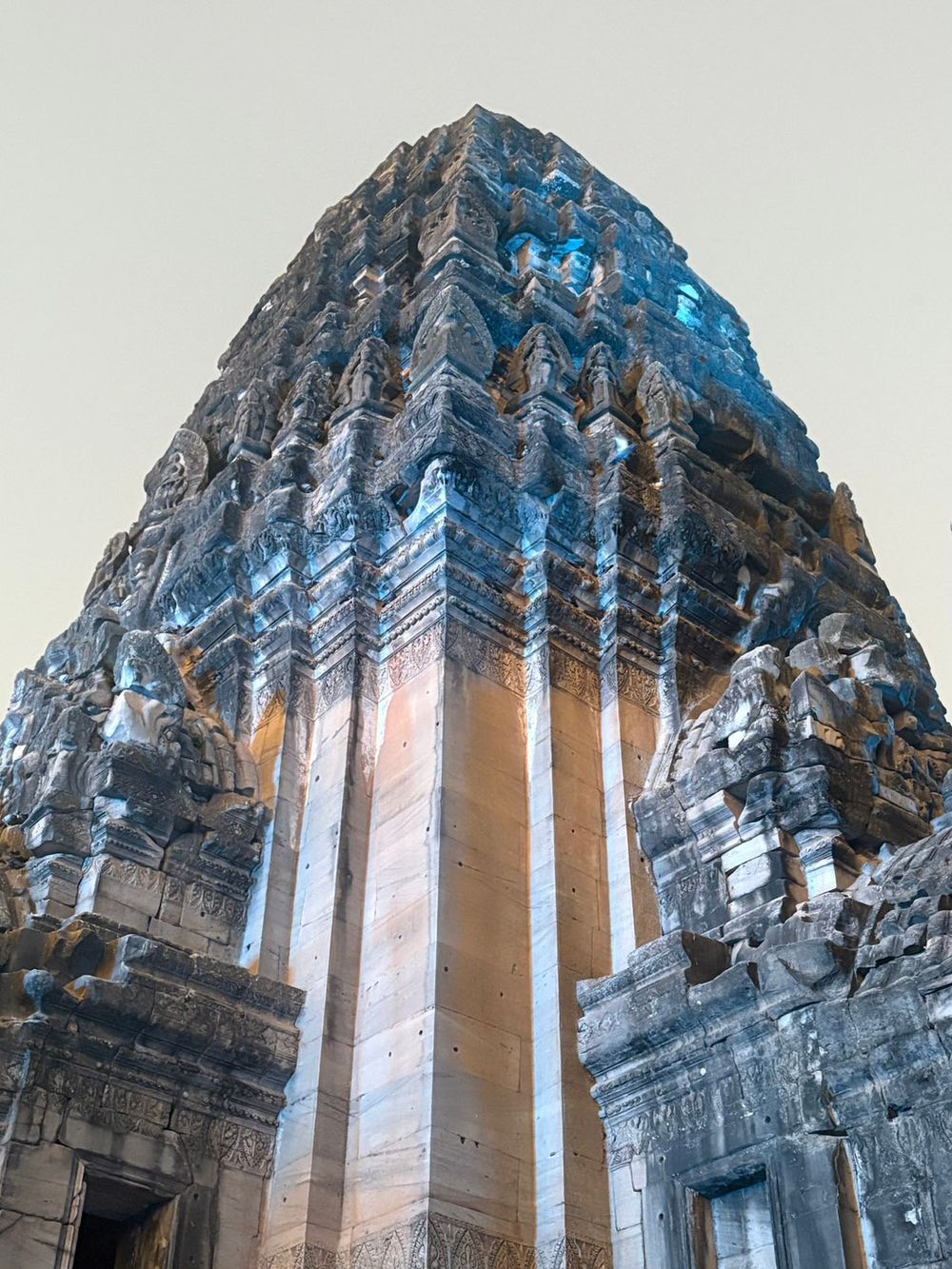
Ajarn Phitakchai stated that the reason every temple remains unfinished lies in three traditional tenets of construction: 1. When a King ascends to the throne, he must build a sanctuary to dedicate to the deity he worships, making it the sanctuary of that reign. 2. Sanctuaries are built to dedicate to ancestors. 3. A “Baray” (reservoir) must be constructed to store water for consumption. Furthermore, every sanctuary must have an auspicious time (Ruek) for its opening. Once opened, construction must cease. No further additions are allowed unless an entirely new building is constructed, such as the Prang Brahmadat.
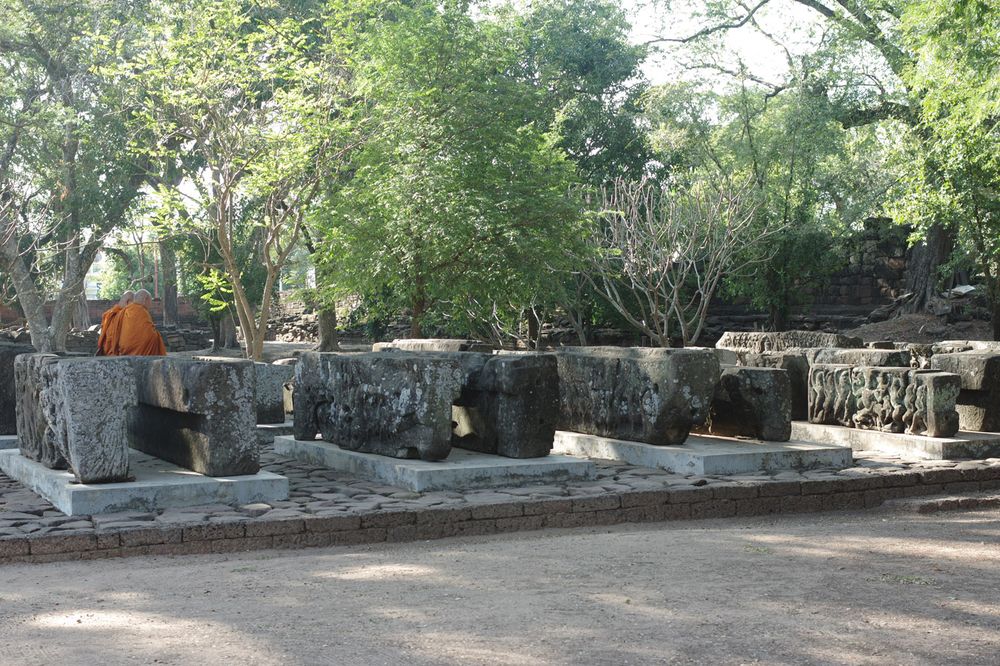
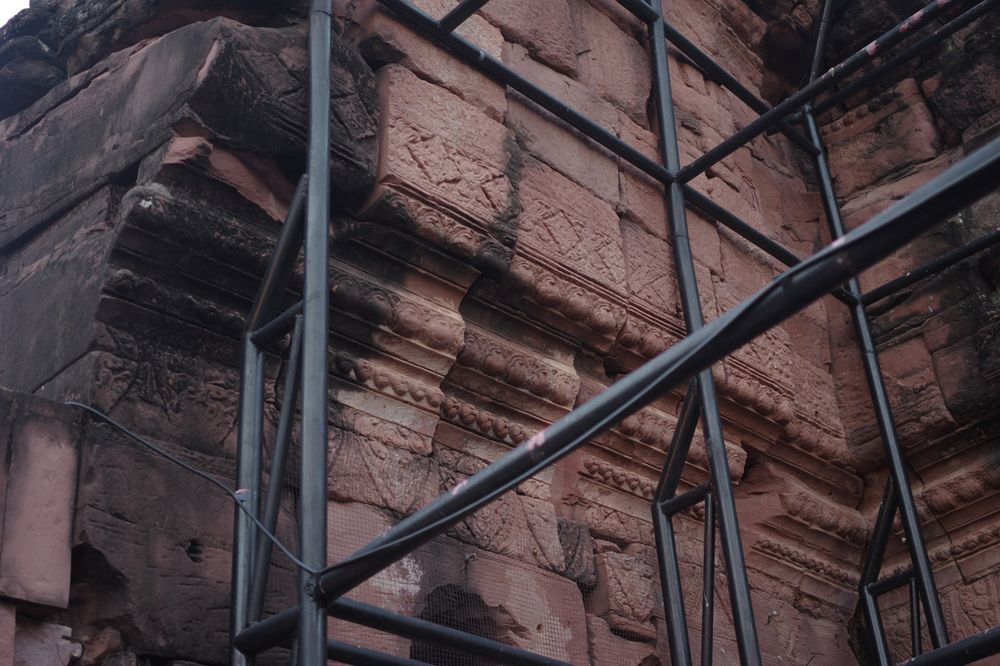
“When building a sanctuary, they would set the stones first and then carve them. Once the structure was complete, craftsmen were sent up to carve. Once the opening ceremony took place, work had to stop; it could not continue. It’s not like adding a garage or a kitchen to our houses; doing so would ruin the auspicious timing. The Khmer did not do it. When it was finished, it was finished. Even Angkor Wat, the great temple and a wonder of the world, remains unfinished. The carvings on the eastern and northern sides were never completed and were only carved much later in a subsequent period.”
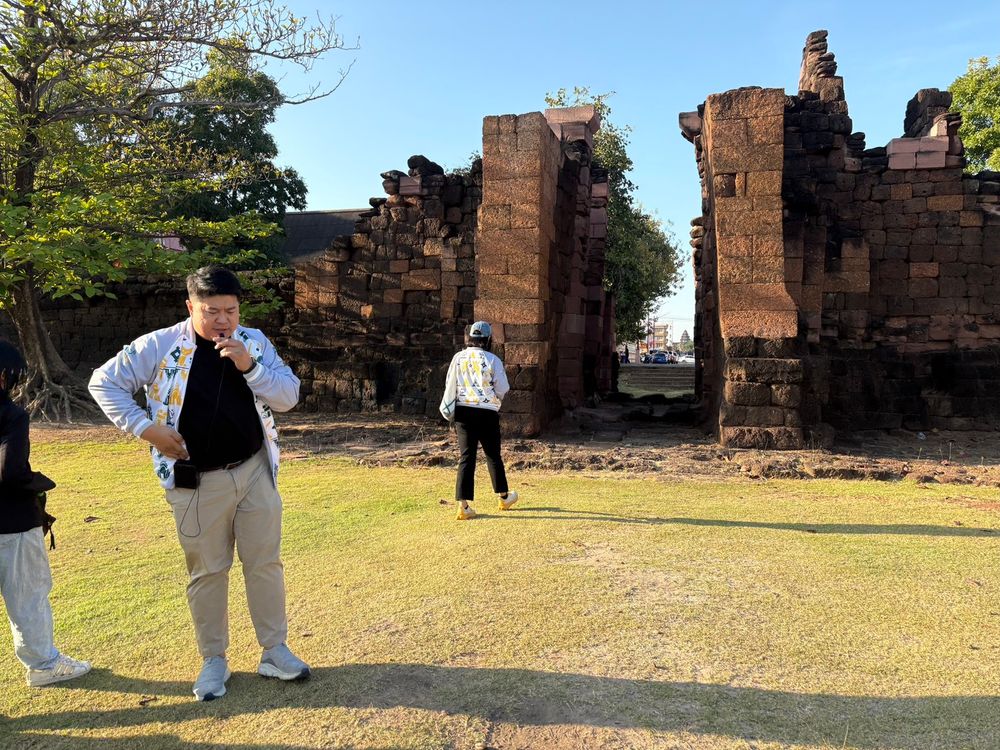
The Wing-Shaped Stairs: The Boundary Between the Human and Heavenly Worlds
One thing our tour leader pointed out before we entered the sanctuary was the central crescent or wing-shaped stairs, which symbolize the division between the human world and the world of the gods.
“Whenever you cross these wing-shaped stairs into the sanctuary, from that point on, you are no longer walking on natural ground but on heaven. Notice the carvings of various flora on the side edges; they symbolize that we are walking through a celestial palace (Vimana) surrounded by flowers floating in the sky.”
Meanwhile, the two layers of the “Kamphaeng Kaeo” (crystal walls) surrounding the sanctuary represent the stone mountains encircling Mount Meru, the center of the universe. The four pits represent the four continents. Each pit has carved floral or botanical patterns. Therefore, these pits should not be filled with water to grow lotuses as was done at Phanom Rung, because water obscures the beautiful carvings.
“If you ask if Phanom Rung knows this, they do. They once removed the water, lotuses, and fish, but people complained, asking why they removed them since it looked beautiful. So, they put the water back. Since those four pits represent continents, that would mean everyone has drowned! (Laughs).”
These patterns are unique to Phimai during the 16th Buddhist Century and are not found elsewhere, such as the petal motifs and the “Pracham Yam Kam-pu” (crab-claw) patterns.
Phimai Sanctuary: The Prototype for Angkor Wat
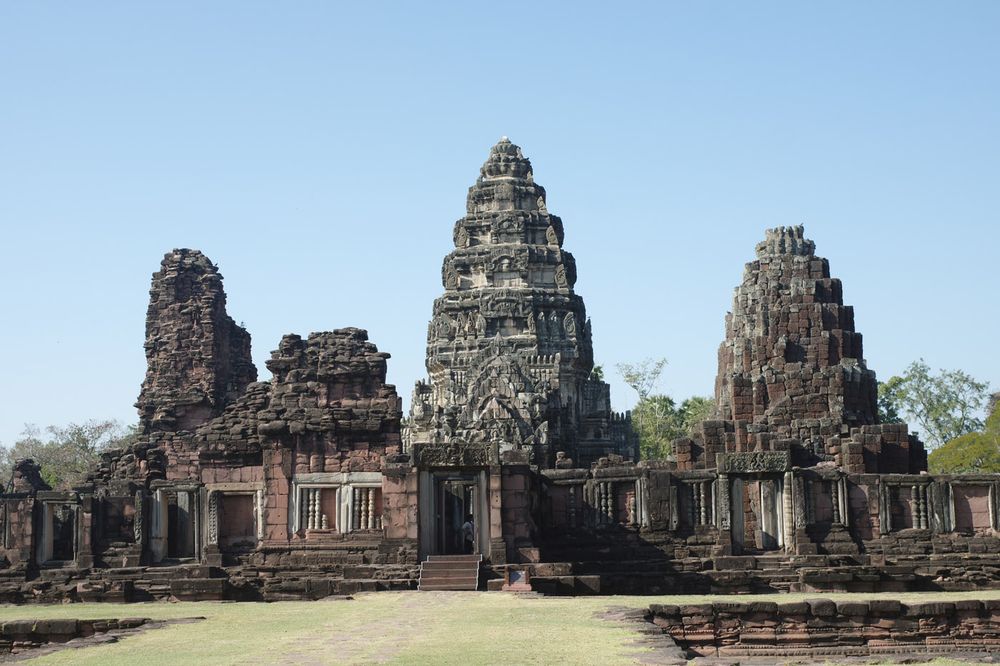
There is academic, historical, and archaeological evidence indicating that Angkor Wat used the Phimai Sanctuary as its prototype.
Ajarn Phitakchai explained that besides the lotus-bud (Phum) shape, the “Pratun” (curved) roof style—which has a rounded arch—is the same as that found at Angkor Wat. Why, then, do we refer to Phimai’s art as “Angkor Wat style”? It is time to call it “Phimai Art.”
This aligns with the hypothesis of Assoc. Prof. Dr. Rungroj Piromanukul, a lecturer at the Department of History, Faculty of Humanities, Ramkhamhaeng University, who noted five points indicating that Phimai is the prototype for Angkor Wat:
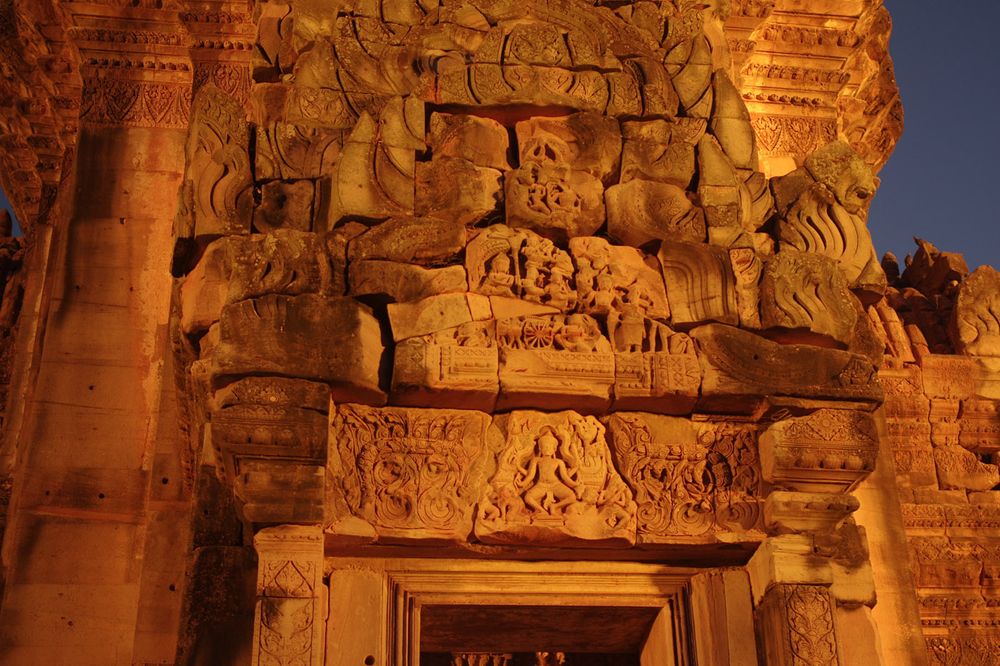
1. The Phimai stone sanctuary is “Phum” (lotus-bud) shaped because the architectural pieces called “Naga-pak” (upward-pointing elements) tilt inward. This served as the prototype for the Naga-pak at Angkor Wat, which has more elongated proportions.
2. The carving of historical scenes as “narrative images” featuring individuals rather than just mythological figures first occurred at Phimai, such as the procession of the Vimaya image. Angkor Wat, built later, features a procession of King Suryavarman II (known to Thais as the “Siam Kuk” image—representing the Siamese people appearing on the historical gallery of Angkor Wat).
3. Pediments featuring multiple Naga heads joined together (Pha-phan) appeared at Phimai before they appeared at Angkor Wat.
4. King Suryavarman II had ancestors in Phimai. The ability to build such a massive temple was possible because people from the Mun River basin migrated toward the Tonlé Sap in Cambodia. Furthermore, resources like iron smelting, which was crucial for temple construction, were also located in Phimai.
5. Cruciform-plan terraces (Chala) were built at Phimai first before being adopted at Angkor Wat. Additionally, details from the Ramayana, featuring multiple scenes, also appeared first at Phimai.
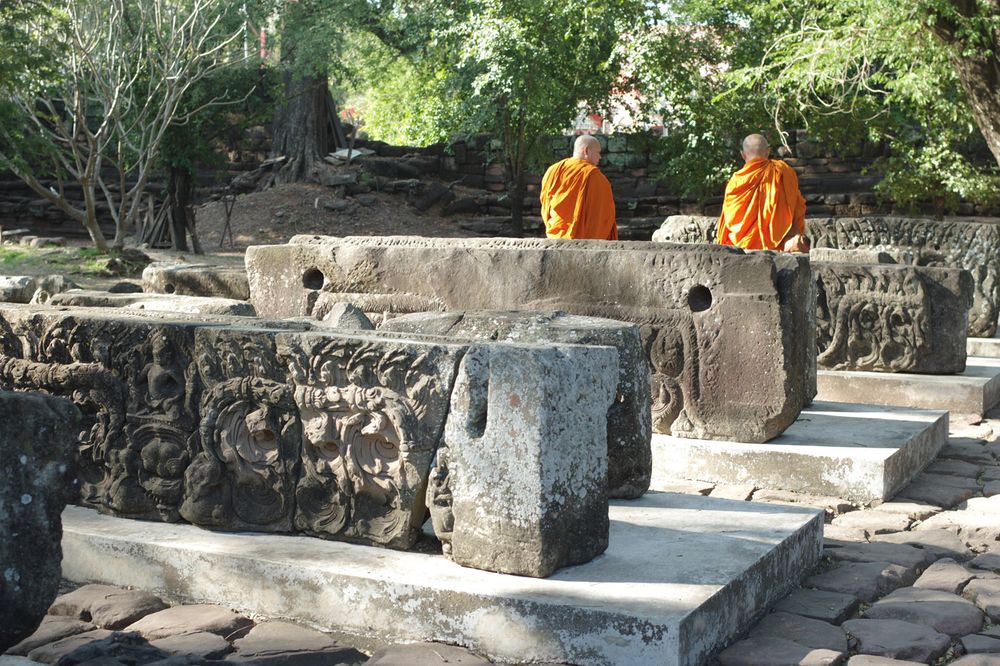
Carvings of Hindu and Buddhist Scenes in Phimai Sanctuary
From the restoration of Phimai, it was found that there are over 170 lintels, reflecting that many doors were built. The issue at Phimai, however, is that most lintels are not in their original positions. All the lintels on the exterior depict the Ramayana. Since Phimai was a Mahayana Buddhist site, Hinduism was positioned as a “servant” on the outside, while the interior of the sanctuary features Buddhist stories.
“There are many more lintels I’d like to show you. One isn't about the Ramayana but depicts Lord Narayana or Vishnu with four arms. Because the southern side already featured Shiva, they wanted to place Vishnu or Narayana on the northern side to demonstrate that Buddhism here held power over Hinduism.”
“Another image depicts the judgment of Thao Maliwarat. What’s interesting is the ‘Busabok’ (movable throne) with a swan base, indicating this pavilion is floating in the celestial air. This image is a miniature of the sanctuary itself. This style of architecture became popular at Angkor Wat. I call this the ‘first photograph’ of the Phimai Sanctuary.”
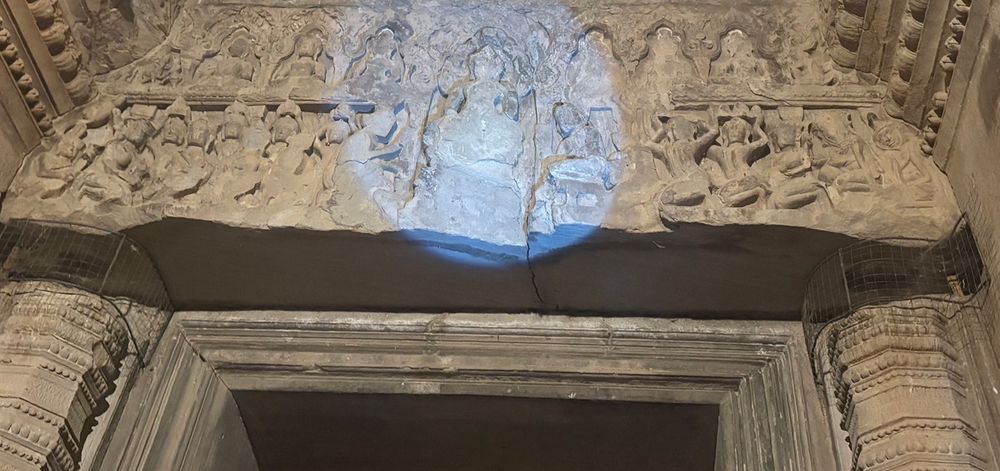
As we move further inside, the patterns on the lintels transition to Buddhist themes.
“The lintel I love most—the most beautiful and significant for this sanctuary—is the one carved as a Buddha in the Naga-protected pose. This is the original piece. This figure is Kamrateng Jagat Vimaya. It dates back to the 18th Buddhist Century during the reign of King Jayavarman VII. I call this piece the ‘first photograph’ of Kamrateng Jagat Vimaya, which is the origin of why we call this place ‘Phimai.’ It is named after this most beautiful and sacred Naga-protected image. Previously, people rarely saw this piece because the room had no lights, making it invisible even during the day. Later, its importance was recognized, and lighting was installed. This room connects the ‘Mandapa’ (ritual hall) and the chamber housing the Kamrateng Jagat Vimaya image built during the reign of King Jayavarman VII.”
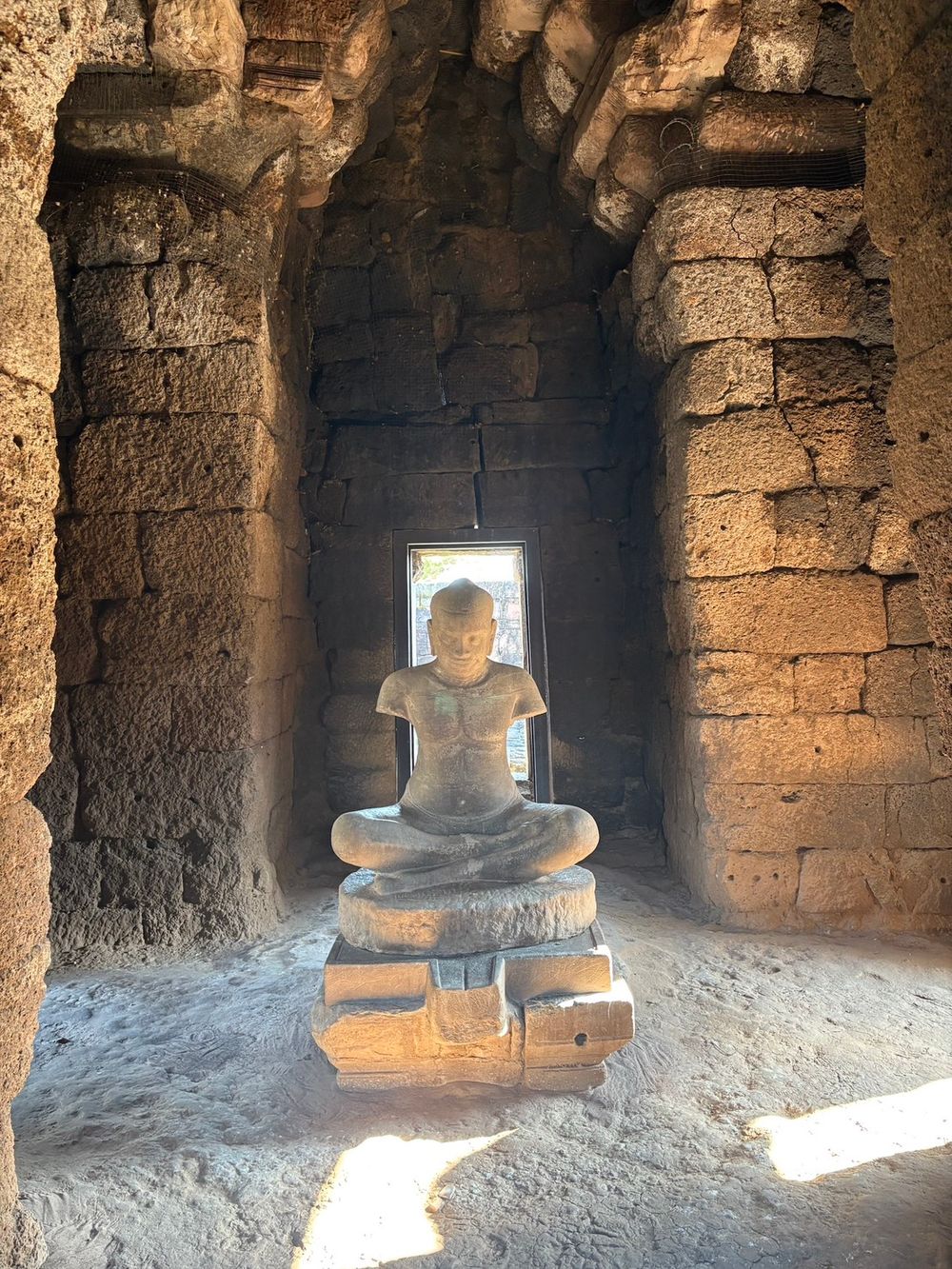
This particular image features the “Bayon smile”—closed eyes, a large nose, thick lips, and a somewhat square face.
“This face is the likeness of King Jayavarman VII. He was very stylistic; any Buddha or Bodhisattva image within his kingdom would share the same face—his face. And it is in the Naga-protected pose because he revered this specific posture. The Naga itself, with a bald head and an upward gaze without a hood (Phang-phan), is the Bayon style of the 18th Buddhist Century. This specific one here is a replica; the original is kept in the Phimai National Museum.”
What to See When the Museum Reopens
For those interested in visiting the Phimai National Museum, which has been closed for a long time, there is recent good news: the museum is preparing to reopen this coming June.
“When the museum opens, it will become the best museum in Thailand. What’s particularly interesting are two important statues: one of the original Kamrateng Jagat Vimaya, and another of King Jayavarman VII. Some might ask why we should honor Jayavarman VII since he was a Khmer king. We must look past the word ‘Khmer’ and see it as a shared culture. More importantly, this was his mother’s home. The reason he placed a statue of himself here in a prayer (Phanom Hat) posture was his faith that this city belonged to his mother—it was his ancestral home.”
Regardless of the current conflicts between the people of the two nations, looking back to the distant past—before the existence of nation-states or borders—people traveled and interacted as kin. The exchange of culture was a common occurrence. If we learn and open our hearts, beyond appreciating the beauty of the art, we can free ourselves from constructed biases and move forward together with understanding.
© 2025 Khaoyai Connect. All rights reserved.
No part of this content may be copied, modified, or distributed in any form without prior written permission.
